Great hammerhead
Sphyrna mokarran · Sphyrnidae
- Saltwater
- Sharks & rays
- Hard
- Protected
- Regulated
- Dangerous
- Size
370–610 cm
- Weight
210–450 kg
- Lifespan
30 years
- Depth
1–300 m
Where to fish
- Reef
- Beach
- Offshore
Habitat icons: Flaticon
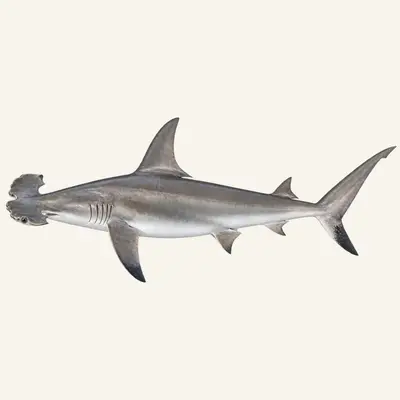
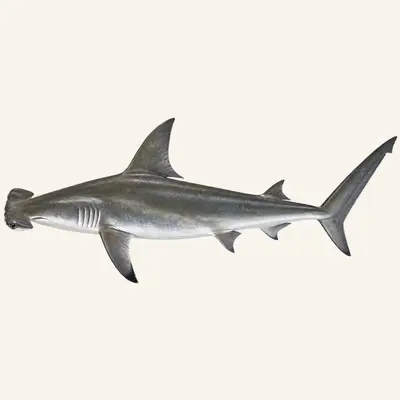
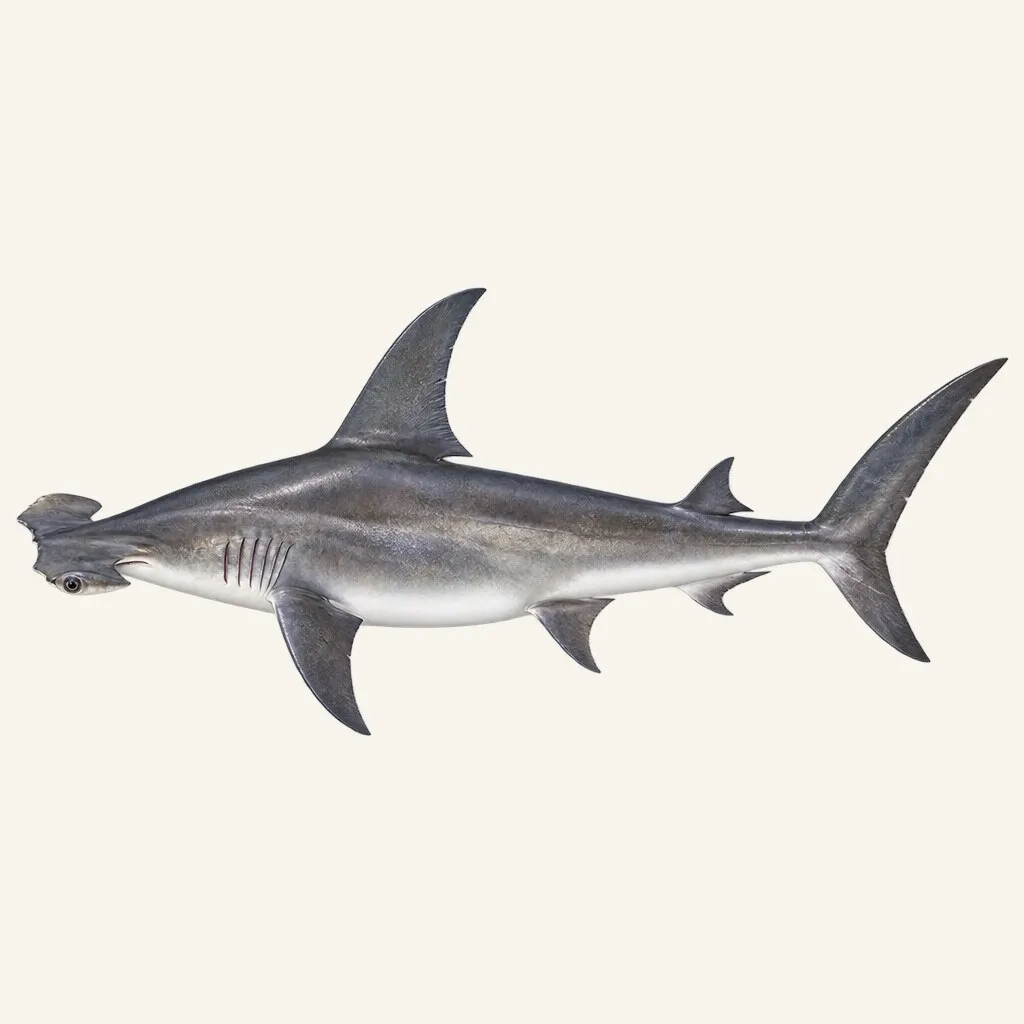
The great hammerhead is the largest hammerhead shark, recognizable by its very broad T-shaped flattened head with eyes positioned at the tips. This unique morphology gives it panoramic vision and a remarkable ability to track stingrays along the seafloor.
Calendar
Recorded in 10 countries
Australia · Bahamas · Brazil · Faroe Islands · French Polynesia · Mozambique · Puerto Rico · Svalbard & Jan Mayen · United Kingdom · United States
GBIF occurrence records — native and introduced populations combined.
Its range
The range covers the warm seas of the world between 40°N and 37°S, with an explicit status as a highly migratory species.
That status reads on the map in a particular way. This shark is not oceanic: it stays attached to continental shelves, island terraces, passes and lagoons. Its crossings therefore link pieces of relief rather than occupying open water, and its presence around very isolated archipelagos follows from that. Each shelf, however small, is a possible stage.
Identifying it
The head character changes with age, which is what traps identifications. In a juvenile the leading edge describes a gentle curve; in an adult it becomes very nearly straight, with a slight notch surviving at the centre. A young fish therefore resembles its relatives, while a large one has no equivalent: that flat crossbar, almost level from end to end, belongs to this species alone.
The fins finish the job. The first dorsal is very high and falcate, out of all proportion to that of the other hammerheads. The second dorsal and the pelvic fins are high as well, and their rear margins are deeply concave — a detail nobody looks at, and one that is not met elsewhere in the genus.
The colouring adds nothing: light grey or grey-brown above, white below, with no conspicuous marking on any fin. A dusky pectoral tip or a smudge on the caudal points to another species.
Size then speaks for itself. An ordinary individual measures 3.7 m: this is the largest hammerhead by a wide margin.
Breeding
Gestation runs to about eleven months and the litter to between thirteen and forty-two pups, six to forty-two across the various series, with newborns of 50 to 70 cm. Each embryo is joined to its mother by a placenta developed from the yolk sac.
Maturity falls between 2.1 and 3 m, averaging 2.5, in an animal that keeps growing long after it and lives some thirty years. A female therefore spends a considerable part of her existence below the length at which she begins to count towards the renewal of her population.
The water it needs
This is the hammerhead of the bottom and the reef. Depth runs from 1 to 300 m, ordinarily from 1 to 100, and the animal stays associated with the substrate between 1 and 80 m for most of its activity.
The places it favours share one geometry: an atoll pass, a lagoon, the lip of a drop-off, a sand flat between two coral heads. These are places where relief obliges prey to pass through a single point, and where sand offers open hunting ground.
Areas
- Tropical coral reefs
- Atoll passes
- Coastal sandy bottoms
- Warm offshore waters
Techniques
- Boat live bait fishing
- Offshore chumming and drifting
- Dead bait over coral bottom
- Tropical trolling
Baits
- Stingrays
- Large whole fish
- Squid
- Bonito
- Flatfish
What it eats
It prefers rays. Stingrays and other batoids head the diet, followed by groupers and sea catfishes, then small bony fishes, crabs, squid, other sharks and lobsters.
That preference explains the shape of the head, and it is the fact that gives the whole genus its meaning. The cephalofoil is not a rudder: it is a mounting. The electroreceptors — the pores that detect the electric fields produced by any working muscle — are spread across its full width instead of being grouped on a narrow snout. The shark sweeps the sand left and right the way a detector is swept, and a buried ray, invisible and giving off no scent, betrays itself by the beat of its gills alone.
A flatfish lying under two centimetres of sediment is therefore, for this animal, entirely findable. No narrow-snouted predator has that coverage.
How to catch it
The diet names the bait. A whole ray, or failing that a large whole fish, corresponds exactly to what the animal is looking for, and the methods used place it on the bottom or on a slow drift above sand rather than at the surface.
The geography names the mark. Atoll passes, lagoon mouths, tongues of sand between coral heads: the fish patrols them, and the useful depth stays shallow against the 300 m on record.
Mass dictates the rest. An adult of this species is far too heavy to bring aboard; everything is settled in the water, at arm's length, with a long tool. The species is held to be potentially dangerous, and the documentation adds one qualification that amounts to a warning: the rare attacks attributed to large hammerheads are almost never traced to a definite species, for want of any way to tell them apart at the time.
A last point belongs to conduct. This is a species whose numbers have fallen hard, and an individual of this size is necessarily a breeder. The fight is kept short, the line cut close to the iron, and the animal leaves without having been taken out of the water.
Protected — Sensitive or protected species depending on area: check local rules before taking action.
Regulated — Often governed by quotas, size limits, seasons, or reporting rules.
Dangerous — Risky handling: gear, release, and safety practices must be adapted.
Conservation · Critically Endangered (IUCN) — This species is threatened with extinction. Always release it (no-kill), handle it with the utmost care and check local rules — fishing for it may be prohibited.
Conservation
Its dorsal fin is its sentence. Very high and sail-like, it ranks among the most sought-after pieces in the fin trade, and the tail with it. A single individual is therefore worth far more than its meat, and that value is enough to ensure that no accidental capture goes back over the side. The character that identifies the species is the one that gets it killed.
The rest of the animal has outlets as well: meat fresh, frozen, dried-salted or smoked, liver oil for vitamins, hide for leather, carcass for fishmeal. It is taken occasionally by shark longlines, demersal tangle nets and tuna gillnets — three gears, none of which is aimed at it.
Set against those removals, the renewal figures are unfavourable at every point: first breeding beyond two metres, gestation of nearly a year, thirty years of life at best. The large individuals, the ones fishing seeks out and the ones the fin trade values, are precisely the fraction everything depends on.
International trade is monitored under CITES Appendix II. That listing requires exports to be declared; it fixes no ceiling on what may be taken, and a declaration is not a limit.
Regulations
Check the local regulations in force (legal size limits, closed seasons, bag limits).
For guidance only. Legal sizes, quotas and open seasons vary by location and season: always check the local regulations in force before fishing.
Other names
Great hammerhead in English, grand requin marteau in French, Großer Hammerhai in German: the name is a superlative in every language, and for once it is accurate. The epithet mokarran comes from an Arabic name for the fish, which is unusual in a genus otherwise named from Greek.
The practical difficulty is not the name but the market. Hammerhead fins arrive in trade as fins, and the three species are not separable once the animal has been finned and the trunk discarded. A catch statistic that says hammerhead therefore covers three animals with different sizes, different ranges and different rates of renewal.
Sources: fishbase.se · api.gbif.org