Great white shark
Carcharodon carcharias · Lamnidae
- Saltwater
- Sharks & rays
- Hard
- Protected
- Regulated
- Dangerous
- Size
640 cm
- Weight
1,905 kg
- Lifespan
36 years
- Depth
0–1,280 m
Where to fish
- Offshore
Habitat icons: Flaticon
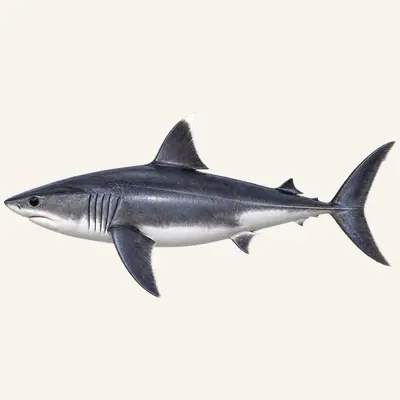
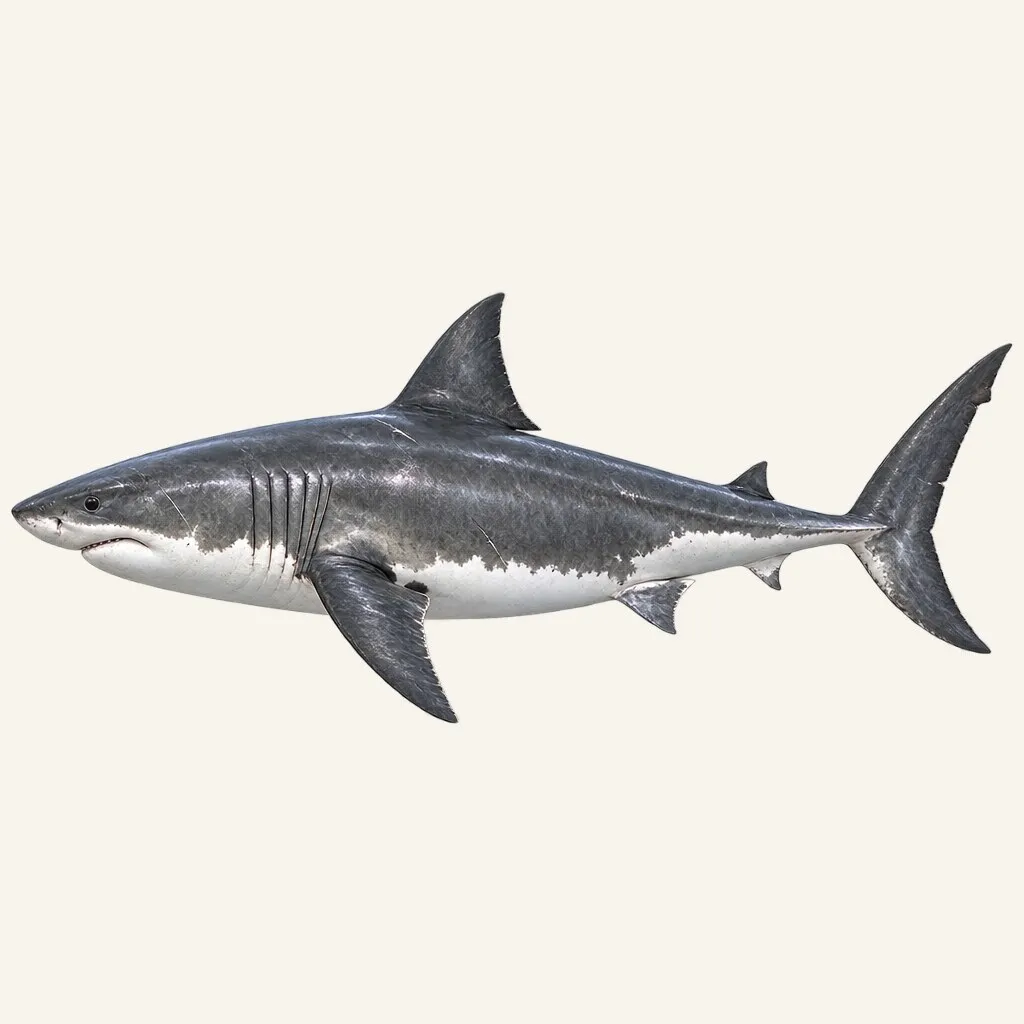
The great white shark is the largest predatory fish alive today, recognizable by its massive fusiform body, stark white underside contrasting with the slate-grey back, and broad serrated triangular teeth. It inhabits temperate and subtropical coastal and pelagic waters worldwide.
Calendar
Recorded in 8 countries
Australia · Brazil · Canada · Mexico · New Zealand · South Africa · United Kingdom · United States
GBIF occurrence records — native and introduced populations combined.
Its range
Almost every sea, from 61 degrees north to 58 south, in water from 5 to 25 degrees. Twenty degrees of thermal amplitude is what gives this fish one of the widest combined habitat and geographic ranges recorded for any fish at all.
Like the other mackerel sharks it retains part of the heat its muscles generate instead of losing it at the gills, and works above the temperature of the water it is in. That reserve opens the cold without closing the warm, which is the unusual half of it. Where the porbeagle is walled off by tropical water, this species crosses it; where the large tropical sharks stop at the edge of cool temperate seas, this one carries on.
It also enters brackish water.
Identifying it
A newborn measures 120 to 150 cm. Start there, because every other fact about this animal is downstream of it.
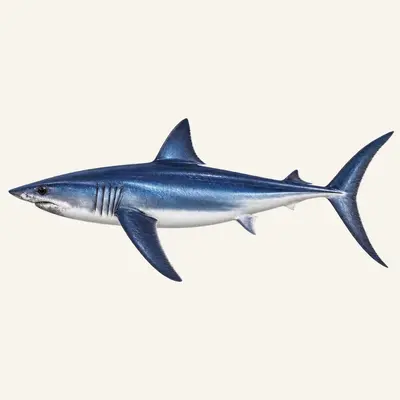
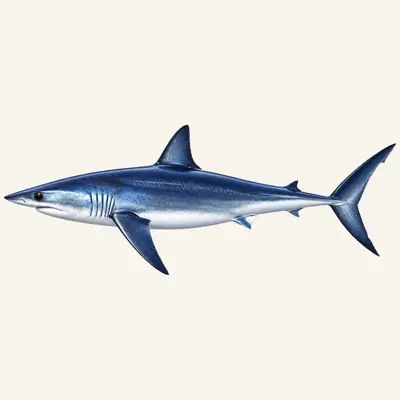
The look of the adult is a boundary rather than a gradient. Lead-grey to brown or black over the back, lightening a little along the sides, then switching to white with no transition at all. That hard edge is the first thing visible on a fish at the surface. A second mark completes it and needs only a glance underneath: a black spot at the rear of the pectoral fin base, in the fin's armpit — small, constant, easy to check.
The snout is blunt and conical on a massive head, and the eye is round and black in a face that carries nothing else to look at. The caudal is crescentic. The origin of the first dorsal usually falls over the inner margins of the pectorals.
The teeth are broad, triangular and saw-edged along their whole margin. That is not the narrow smooth blade of a mako nor the notched cutter of a tiger shark. It is a bread knife, made to work through a mass larger than the jaws holding it.
On size, more caution is required here than anywhere else in this catalogue. The largest figures in circulation come from measurements now judged doubtful, and the most famous record of all has been established as incorrect. Published maxima disagree with one another, and picking one of them is a choice rather than a finding.
Breeding
Development is aplacental and the embryos are fed on eggs. Once the yolk sac is used up they consume the unfertilised ova the mother goes on producing, and the entire litter is built out of that supply.
The output is seven to fourteen young, sometimes fewer than ten. Beside the spawn of a bony fish that is a derisory number, and it buys something a bony fish never gets: each pup leaves the mother at a length most adult sharks never reach. There is no vulnerable phase. The animal begins its life above the size of nearly everything that could otherwise eat it.
Mating requires a distinct pairing with an embrace, and the two may swim in parallel while copulating.
First maturity arrives at 450 to 500 cm, averaging 475, in an animal whose recorded longevity is 36 years. Compare that against the measurements block on this page and the shape of a female's life falls out of it: the greater part of it is spent becoming capable of breeding, and what follows is counted in tens of offspring rather than thousands.
The water it needs
Continental and insular shelves, from the edge out to deep water, and around oceanic islands a long way from any land. It comes readily to the surf line and pushes into shallow bays.
The ordinary depth band runs from the surface to about 250 m. A far larger figure, 1,280 m, has circulated since a 1948 survey and was established as erroneous in 2012. Sixty years of citation did not make it true, and it still appears on reference pages that have not been revised.
Socially the animal is solitary or moves in pairs. It gathers at ten or more, but only around food, and it does not form schools. A group of great whites is a feeding event, not a society.
Areas
- Temperate to warm coastal waters
- Around islands and archipelagos
- Deep pelagic zones
Techniques
- Observation only (protected species)
- Cage diving (observation)
- Scientific fishing under permit
Baits
- Whole fish (scientific bait)
- Fish blood and oil (attractant)
- Olfactory lures (research)
What it eats
Bony fishes, other sharks, rays, seals, dolphins and porpoises, sea birds, squid, octopus, crabs, whales and carrion. Almost nothing on that list constrains where the animal has to be, which is the point of a menu that broad.
The dentition is what makes the heavy end of it possible. A serrated triangular blade is a saw, and a saw takes a portion out of an animal too large to be swallowed — the difference between a predator limited to prey that fits in its mouth and one that is not limited at all. Nothing else in the diet requires explaining once that is understood.
Whale carrion deserves separate mention. A floating carcass carries an amount of energy no hunt can deliver, and it is around resources of that kind that the aggregations of ten and more form.
How to catch it
The species is protected across much of its range. Directed capture is prohibited or tightly controlled in a great many countries, its international trade is monitored under Appendix II of CITES, and it appears on both Appendices I and II of the migratory species convention, the first of those covering endangered migratory animals that range states undertake to protect. Whatever applies locally is verified with the competent authority before a boat leaves.
That leaves the encounter, which is a real question in ordinary sea fishing. The animal is classed as traumatogenic and is implicated in attacks on people, and the record adds a detail worth having: most of those attacks happen in estuaries. Shallow, often turbid water, where a predator that misidentifies what it is approaching is in exactly the place people are.
For anyone who meets one while fishing for something else, two things follow. It is not an animal that comes aboard. And the flesh has been reported to cause poisoning, so there is nothing to be gained at the other end either.
Protected — Sensitive or protected species depending on area: check local rules before taking action.
Regulated — Often governed by quotas, size limits, seasons, or reporting rules.
Dangerous — Risky handling: gear, release, and safety practices must be adapted.
Conservation · Vulnerable (IUCN) — This species is threatened with extinction. Always release it (no-kill), handle it with the utmost care and check local rules — fishing for it may be prohibited.
Conservation
The demography is about as unfavourable as a page in this catalogue can record. First breeding at 450 to 500 cm, seven to fourteen young, 36 years of life: a female spends most of her existence reaching the state of being a breeder, and her total lifetime output is a number you can count.
What presses on her has an unusual shape. For most large sharks the value is in the flesh and the fins, so a capture has to be justified by weight. Here a single part will do. The record shows animals taken by big-game anglers and by line boats for their jaws. A trophy that pays for the trip on its own destroys any proportion between fishing effort and landed tonnage, and landing statistics are built on tonnage — they do not see this kind of removal at all.
Around that sit the ordinary uses: flesh fresh, dried-salted and smoked, skin for leather, liver for oil, carcass for fishmeal, fins for soup, teeth and jaws as ornaments.
Then there is where the animal goes. Surf lines, enclosed bays and estuaries are the most heavily used water on the planet, and this species uses them too. Size confers no refuge when the animal in question is willing to come into a metre of water.
Regulations
Check the local regulations in force (legal size limits, closed seasons, bag limits).
For guidance only. Legal sizes, quotas and open seasons vary by location and season: always check the local regulations in force before fishing.
Other names
Great white shark in English, and white shark in most of the literature, where the adjective of scale is treated as an angler's and a journalist's addition rather than part of the name. The colour word is doing less than it appears to in either version: white describes only the underside, which is the surface a prey animal beneath it sees, and the fishermen who named it were naming the view from below.
Australian and New Zealand English says white pointer as well, adding the conical snout to the colour.
The scientific name repeats itself. Carcharodon joins two Greek roots meaning ragged tooth, and the epithet carcharias is the first of the two again. The binomial therefore states one character twice, and that character is the serration — which is why an isolated fossil tooth is enough to name the genus.
Sources: fishbase.se · api.gbif.org