Smooth hammerhead
Sphyrna zygaena · Sphyrnidae
- Saltwater
- Sharks & rays
- Medium
- Protected
- Regulated
- Dangerous
- Size
335–500 cm
- Weight
253–400 kg
- Lifespan
21 years
- Depth
0–200 m
Where to fish
- Offshore
Habitat icons: Flaticon
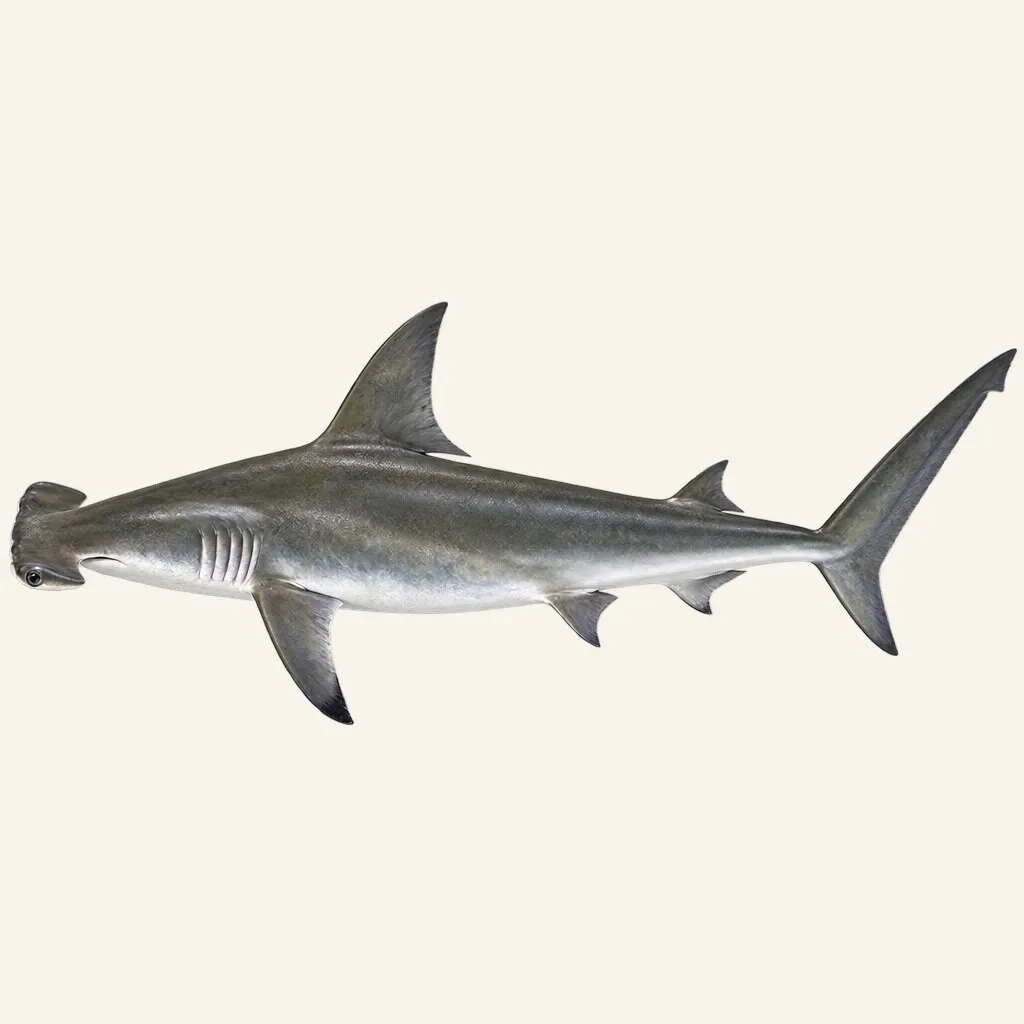
The smooth hammerhead is a pelagic, robustly built species whose hammer-shaped head has smoother edges than its relatives. It inhabits both coastal and offshore waters in temperate and tropical zones, often near the surface or in mid-water.
Calendar
Recorded in 14 countries
Australia · Chile · Ecuador · Faroe Islands · Germany · Italy · Japan · Mexico · Mozambique · New Zealand · Portugal · South Africa · Spain · United States
GBIF occurrence records — native and introduced populations combined.
Its range
Fifty-nine degrees north, fifty-five degrees south: this is by far the widest span of latitude in the genus. Where its relatives stop around the forty-sixth parallel, this one pushes into frankly temperate seas.
That tolerance of cold changes the terms on which it is met. It is the only hammerhead a fisherman in western Europe, South Africa or New Zealand has any chance of crossing without leaving home waters, and it is also the only one whose range overlaps the most heavily industrialised fishing grounds on the planet.
Movement follows the season. The animals run north in summer and drop back afterwards, so their presence at the edge of the range is a matter of a few months rather than a settlement.
Identifying it
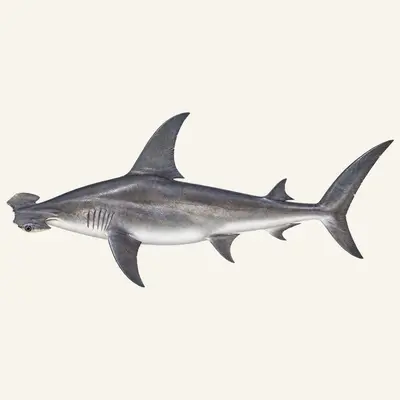
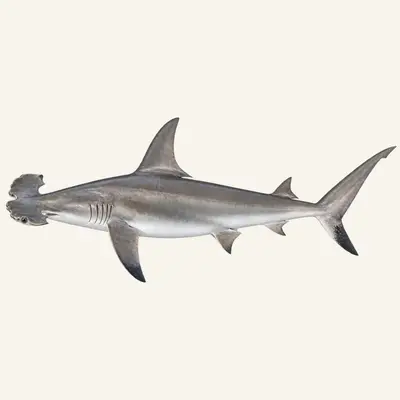
Nothing cuts into the middle of the brow. The head describes an even curve from one end to the other, without the least central notch, and that absence is the decisive character: the two other hammerheads of this size both carry one, pronounced in the first, reduced to a nick in the second. The lateral indentations, by contrast, stay well marked.
The snout is short — a fifth to less than a third of the width of the head — which gives the whole a compact rather than a stretched outline. The mouth forms a broad arch.
The fins sit low. The first dorsal is of moderate height, the second dorsal and the pelvics low: the exact opposite of the great hammerhead's high canvas, and the quickest way to separate the two on an animal seen in profile.
The back runs to olive-grey or dark grey, the belly is white, and only the undersides of the pectoral tips are smudged. The body is angular in cross section.
Breeding
The litter is the largest in the genus: twenty to fifty young, thirty to forty in the best-documented series, after a gestation of ten to eleven months and a birth size of 50 to 60 cm.
That abundance does not make up for the rest. Maturity comes only between 2.5 and 3 m, in an animal that tops out at five metres and whose recorded longevity does not exceed 21 years. This is the shortest life of the three large hammerheads, and it leaves few breeding seasons to a female who has spent half of it getting there.
The water it needs
It occupies the surface layer. Recorded depth runs from zero to 200 m, ordinary use from zero to 20, and the animal readily holds bottom association between 1 and 139 m depending on the sector.
It works the near shore and the open sea alike, over continental and insular shelves. Thermal fronts and current lines concentrate it, because they first concentrate what it lives on.
The young gather, often in hundreds. Those aggregations of small fish are seasonal and local, and they are the form in which the species is most often encountered.
Areas
- Open pelagic surface waters
- Marine thermal fronts
- Coastal current zones
- Temperate and tropical high seas
Techniques
- Surface trolling
- Drifting live bait
- Offshore chumming
- Surface lure fishing
Baits
- Mackerel
- Bonito
- Squid
- Sardines
- Small pelagics
What it eats
It eats mainly elasmobranchs. Small sharks, skates and stingrays come first, which is unusual: most large marine predators take rays occasionally, this one prefers them, and adds other sharks besides.
The rest of the menu drops down the scale with no obvious logic — bony fishes, shrimps, crabs, cephalopods, and as far as barnacles. A predator that consumes fixed cirripedes is not restricting itself to what swims past.
How to catch it
The animal is taken at the surface, which follows directly from the layer it occupies. Surface trolling, drifting live baits, lures worked high: deep presentations do not meet it, or only by accident.
Season counts for more than the mark. The summer run into high latitudes opens a window of a few months at the northern edge of the range, and that window closes. Looking for the species out of season in the same water means fishing ground it has left.
Two warnings come with the catch. The first is conventional: the animal is classed as traumatogenic, and its occurrence in temperate water is the main reason few incidents are formally attributed to it. The second is rarer and worth knowing: poisoning has been reported after eating it. A shark of this size accumulates in its tissues whatever its food chain passes up, and keeping one is not a neutral decision.
Protected — Sensitive or protected species depending on area: check local rules before taking action.
Regulated — Often governed by quotas, size limits, seasons, or reporting rules.
Dangerous — Risky handling: gear, release, and safety practices must be adapted.
Conservation · Vulnerable (IUCN) — This species is threatened with extinction. Always release it (no-kill), handle it with the utmost care and check local rules — fishing for it may be prohibited.
Conservation
Geographical overlap is the central problem. A range extending to the fifty-fifth parallels crosses the great longline fisheries for tuna and shark in the North Atlantic, the Pacific and the southern hemisphere. The species is not targeted, it is encountered, and it is encountered everywhere.
Large litters mislead about the capacity to rebuild. Fifty pups per birth create an illusion for as long as the twenty-one years of life and the 2.5 m to be covered before the first of them are left out of the calculation. Compared with the hammerheads of warmer water, this animal produces more young and has less time in which to produce them.
What remains is that the animal migrates between waters belonging to different states. Its listing on Appendix II of the Convention on Migratory Species addresses exactly that point: coordinating the management of a population that no single jurisdiction contains. The listing obliges nobody to catch less; it obliges the states sharing the stock to agree on what less would mean.
Regulations
Check the local regulations in force (legal size limits, closed seasons, bag limits).
For guidance only. Legal sizes, quotas and open seasons vary by location and season: always check the local regulations in force before fishing.
Other names
Smooth hammerhead in English. The adjective states precisely what the identification looks for: a smooth brow, without the median indentation of the other species. French says requin marteau commun, which merely notes that it is the one most often met — true only in temperate water.
The epithet zygaena is the word by which Greek authors of antiquity already designated these broad-headed sharks. It is one of the few marine fish names to have reached modern nomenclature without passing through a fresh description.
Sources: fishbase.se · api.gbif.org