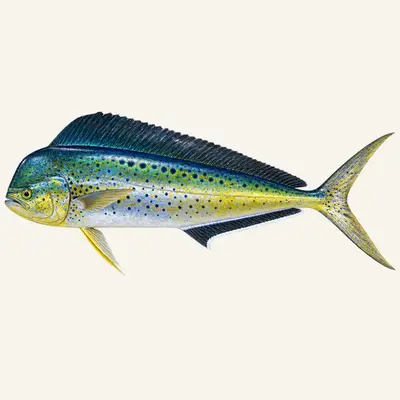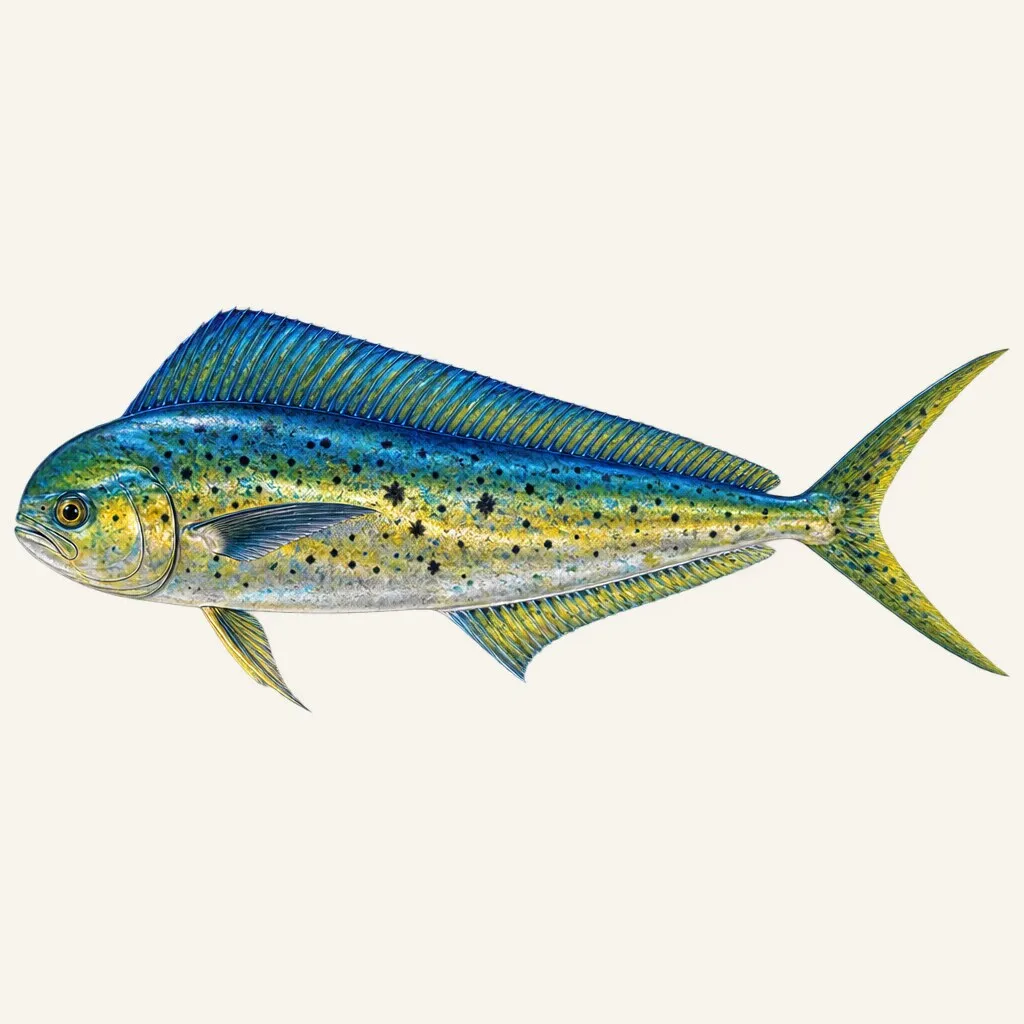
Pompano dolphinfish
Coryphaena equiselis · Coryphaenidae
- Saltwater
- Coastal
- Medium
- Size
50–146 cm
- Weight
1.4 kg
- Lifespan
4 years
- Depth
0–400 m
Where to fish
- Rocky shore
- Offshore
Habitat icons: Flaticon
The pompano dolphinfish closely resembles the common dolphinfish but is distinguished by a less pronounced forehead, a stockier body, and a smaller maximum size. Like its relative, it displays an iridescent yellow-green coloration and inhabits pelagic oceanic waters of tropical and subtropical regions.
Calendar
Recorded in 20 countries
Benin · Colombia · Costa Rica · Ecuador · El Salvador · France · French Polynesia · Gabon · Guatemala · Mauritius · Mexico · Mozambique · New Caledonia · Nicaragua · Panama · Réunion · Seychelles · Spain · United Kingdom · United States
GBIF occurrence records — native and introduced populations combined.
Its range
Tropical and subtropical seas worldwide, with a thermal floor at 24 degrees.
That floor sits three degrees above the one recorded for the common dolphinfish, and it fits the rest of the portrait: this is the more strictly warm-water of the two as well as the more strictly oceanic. It does not follow its relative into the cooler margins of the shared range — which makes those margins the one place where a capture can be assigned to a species without anyone looking in its mouth.
Identifying it
Look in the mouth. The tooth patch on the tongue is broad and square and covers between 50 and 60 per cent of its surface. On the larger dolphinfish the equivalent patch is small and oval. This is the character that decides the question, it takes one look, and it works on a fish of any size.
The second check is the outline of the anal fin. Its front edge is convex here — bowed outward along its leading margin — where the other species carries a hollowed edge on the same fin. The dorsal begins on the nape and holds 52 to 59 rays; the anal has 24 to 28; there are 33 vertebrae, of which about 20 are caudal.
Proportion supports both. In an adult, body depth goes into the standard length fewer than four times, which is to say the body is more than a quarter as deep as it is long. That makes this the deeper-bodied of the two, and it is the reason the fish looks stockier for its length. The pectoral fin runs to about half the length of the head, rather than more than half.
One character that looks decisive is not. Large adults of this species also develop a bony crest and a vertical head profile, more strongly in males than in females, so a squared-off forehead identifies a sex and not a species.
The warning attached to this animal in the literature should be read before any of the above. It is frequently identified as a juvenile or a female of the common dolphinfish. That is the standard error, it is committed constantly, and the tongue and the body depth are the only way out of it.
The water it needs
Primarily an oceanic fish, though it will enter coastal water. It schools, and its recorded depth range reaches 400 m in water from 24 degrees upward.
That depth figure separates the two dolphinfishes as an argument about where they live rather than about how they are built. The common species is a fish of the shelf edge and the surface, usually working the top five to ten metres and not recorded much below 85. This one is a creature of the open basin with several hundred metres of water available to it. They are not living in the same place, which is precisely why the confusion survives: they are met together at the surface, where only one of them belongs by preference.
Two behaviours put it within reach. It follows boats, and it is found beneath objects drifting at the surface.
Areas
- Open pelagic waters
- Around floating objects
- Warm current lines
- Offshore wrecks
Techniques
- Surface trolling
- Soft lure fishing
- Light spinning
- Live bait fishing
Baits
- Small flying fish
- Squid
- Surface lures
- Minnow plugs
What it eats
Small fishes and squid. The list is identical to the one recorded for the larger dolphinfish, which is one more reason the two get filed together: nothing in the stomach contents will separate them either.
The difference is where the food is taken. With several hundred metres of water available, this species can work prey that the shelf-edge fish never reaches, and it does so without giving up the surface where both of them feed under drifting cover.
How to catch it
A wake and a raft of weed are the two situations to work, and they are exactly the situations that produce the other dolphinfish. There is no separate fishery for this species and no way of targeting it in preference to its relative.
Which puts everything on the moment of capture. Unless the tongue and the depth of the body are checked before the fish goes in the box, the animal is entered as a small common dolphinfish, and that is the ordinary fate of the species. A fish of 50 cm is at the common length here and would be a juvenile there — the sizes overlap exactly where the misidentification happens.
It counts as an important gamefish in northern South America, and it is marketed fresh and rated highly as food.
Four years is the greatest recorded age, as for its congener. The same headlong growth applies, on the same schedule, in a much smaller animal.
Conservation
A worldwide range in tropical and subtropical seas combines badly with a systematic misidentification. Wherever the two species overlap, which is very nearly everywhere, captures of this one are booked as juveniles of the other. What its numbers are doing is therefore not known, and there is no series that would show it.
The gap goes further than the landings. The published record for this species holds nothing at all on its spawning — no season, no fecundity, no length at first maturity. A fish taken under an assumed identity produces no biology, and two and a half centuries after it was named the account is still largely blank.
Regulations
Check the local regulations in force (legal size limits, closed seasons, bag limits).
For guidance only. Legal sizes, quotas and open seasons vary by location and season: always check the local regulations in force before fishing.
Other names
Pompano dolphinfish in English, and pompano dolphin in older usage. As with the larger species, the word dolphin in the English name invites confusion with the mammals, and mahi-mahi has taken over commercially — a name that covers both fishes without distinguishing them, which suits a trade that cannot tell them apart either.
Both dolphinfishes were named by Linnaeus. The distinction is therefore as old as binomial nomenclature itself, which makes the length of time it has been ignored the more remarkable.
Sources: fishbase.se · api.gbif.org