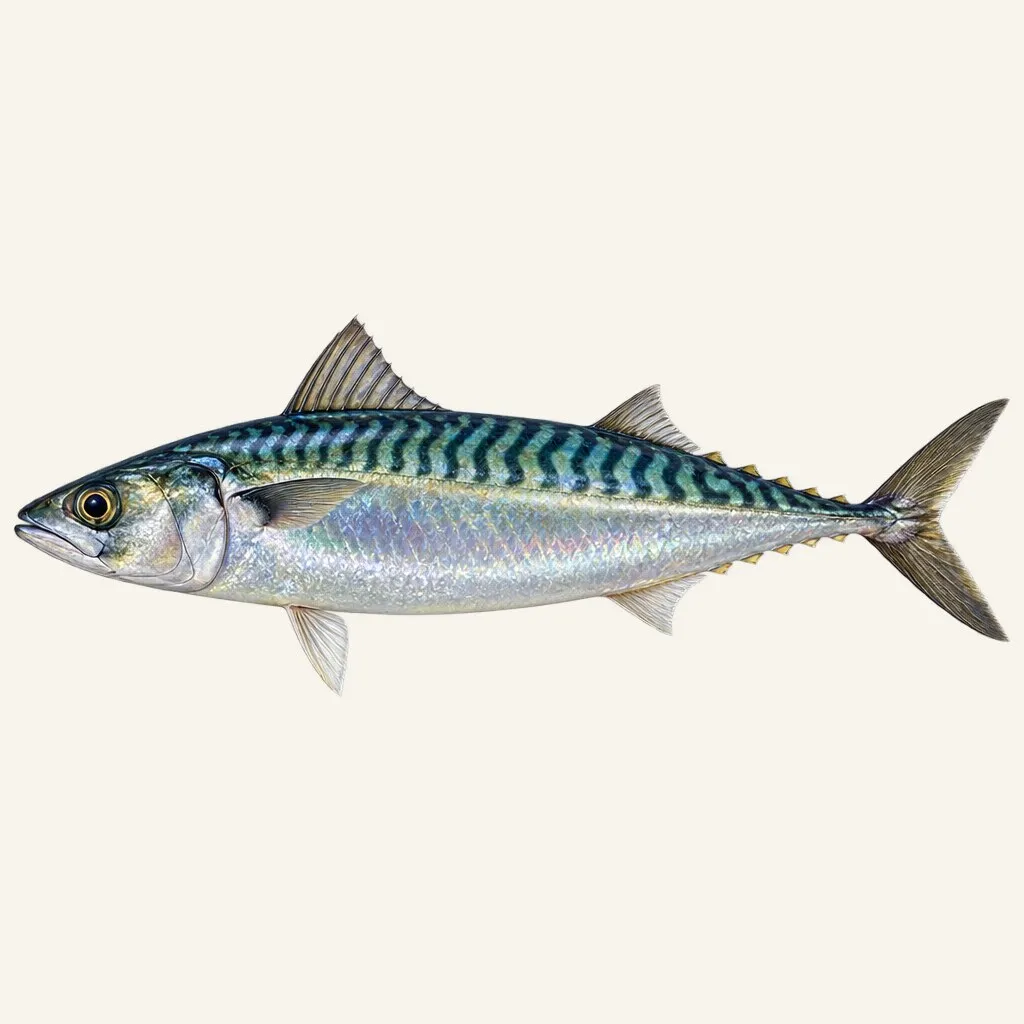
Atlantic chub mackerel
Scomber colias · Scombridae
- Saltwater
- Big pelagics
- Medium
- Size
55 cm
Where to fish
- Rocky shore
- Offshore
Habitat icons: Flaticon
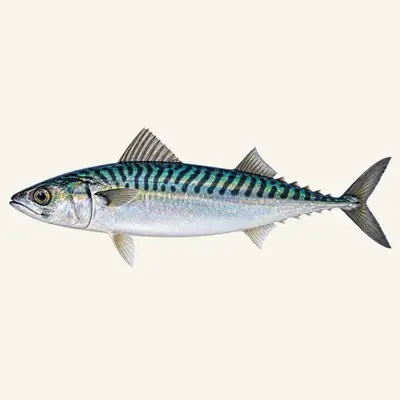
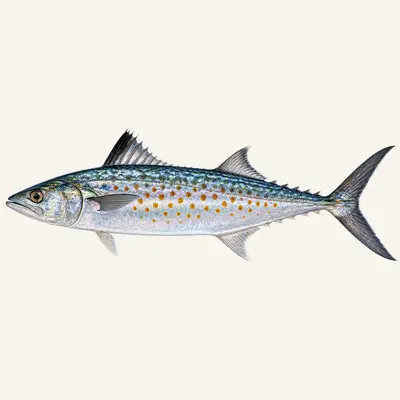
The chub mackerel is distinguished from the Atlantic mackerel by its irregular spots and mottling on the lower flanks and its slightly smaller size. A coastal pelagic species of warm temperate waters, it forms large migratory schools in the eastern Atlantic and Mediterranean.
Calendar
Recorded in 4 countries
Canada · Portugal · Spain · United States
GBIF occurrence records — native and introduced populations combined.
Its range
The Atlantic, on both sides, in the warm part of it, with the Mediterranean and the southern Black Sea included. The species tolerates brackish water and lives over the shelf rather than out in the basin.
Beyond that boundary the record has it replaced by Scomber japonicus, which occupies the equivalent water in the Indo-Pacific. The two accounts are written as a substitution rather than an overlap — one ocean each, the same role in both — and each corrects the other's misattributed records rather than describing a zone they share. That much geographical tidiness is what allowed a single name to serve for two centuries without anyone being obviously wrong.
Identifying it
The published record for this fish holds no description of its own body, and the reason is historical rather than an oversight. For most of the time it has been fished, it was not treated as a species: it was the Atlantic half of the chub mackerel, and everything written about its anatomy was written under the other name. The separation is recent, and the morphological account has not caught up with it.
One colour note survives from before the split, recorded when both fish were described together. The Atlantic form was noted for wavy lines along the belly, where the Pacific one is unmarked below. It is not a key and it should not be used as one, but it is the single character that the older literature attached specifically to this half of the pair.
What is on record for the animal itself is a length at first maturity of 21.3 cm. That is early, and it matters for reasons set out below.
Areas
- Coastal pelagic waters
- Upwelling zones
- Around harbours and jetties
- Offshore beneath bird activity
Techniques
- Metal lure fishing
- Feather lure fishing
- Drifting with live bait
- Light trolling
Baits
- Flasher metal lures
- Coloured feathers
- Small live fish
- Mackerel strips
What it eats
Zooplankton is the basis of the diet at every age, in adults as much as in juveniles. What changes with growth is what gets added to it: cephalopods, crustaceans and small pelagic fishes take on increasing importance as the fish gets bigger.
This is a shift in proportion rather than a change of habit: the animal never stops being a plankton feeder, it merely adds to the list. That is the simplest explanation for where it gets caught. A fish drawing its living from the same plankton as a sardine or an anchovy is in the same water as them for the same reason, which is why the nets set for those two keep bringing it up.
How to catch it
The commercial fishery does not target this species. It is taken chiefly in purse seines and pelagic trawls set for sardine or anchovy, and it usually arrives as by-catch.
One line in the record is worth more than the rest of the section. When the availability of the target species is low, this mackerel has provided an alternative income. That is a description of a buffer: a fish that a fleet turns to when the fish it wanted are not there.
For anyone fishing it deliberately, the consequence is that it is found where the small pelagics are found — over the shelf, in warm water, in company rather than alone.
Conservation
The buffer role is the pressure, and its timing is what makes it awkward. Effort switches onto this species precisely when sardine and anchovy are scarce, which is to say when the system that produces all three is already doing badly. The catch of this fish therefore rises in the years when it is least able to support one, and falls back when the pressure would have cost least.
Maturity at 21.3 cm is what makes the arrangement survivable. A fish that breeds at that length has spawned before it reaches the size the nets are set for, which is not a small thing when the fishery aiming at it does not even mean to.
Regulations
Check the local regulations in force (legal size limits, closed seasons, bag limits).
For guidance only. Legal sizes, quotas and open seasons vary by location and season: always check the local regulations in force before fishing.
Other names
Atlantic chub mackerel in English, or simply chub mackerel where there is no ambiguity — which, in the Atlantic, there is not.
The name itself has been the problem. This fish spent decades inside Scomber japonicus, and market vocabulary was fixed during that period, so trade names and older statistics do not distinguish the two. Any Atlantic or Mediterranean record filed under the Pacific name refers to this animal.
The epithet colias is an ancient Greek word for a mackerel, which makes it one of the older names in the family and a good deal older than the confusion attached to it.
Sources: fishbase.se · api.gbif.org