Atlantic mackerel
Scomber scombrus · Scombridae
- Saltwater
- Big pelagics
- Medium
- Size
30–60 cm
- Weight
0.2–3.4 kg
- Lifespan
17 years
- Depth
0–1,000 m
Where to fish
- Estuary
- Offshore
Habitat icons: Flaticon
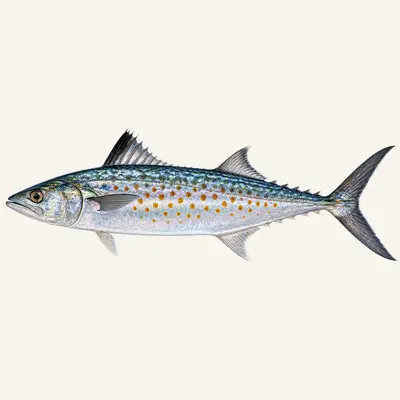
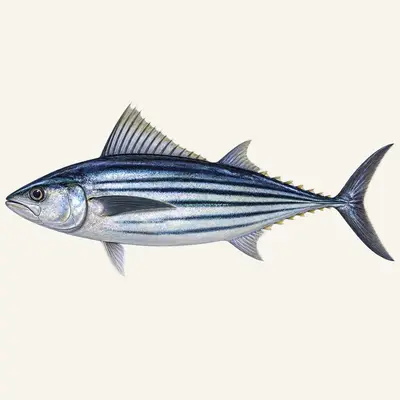
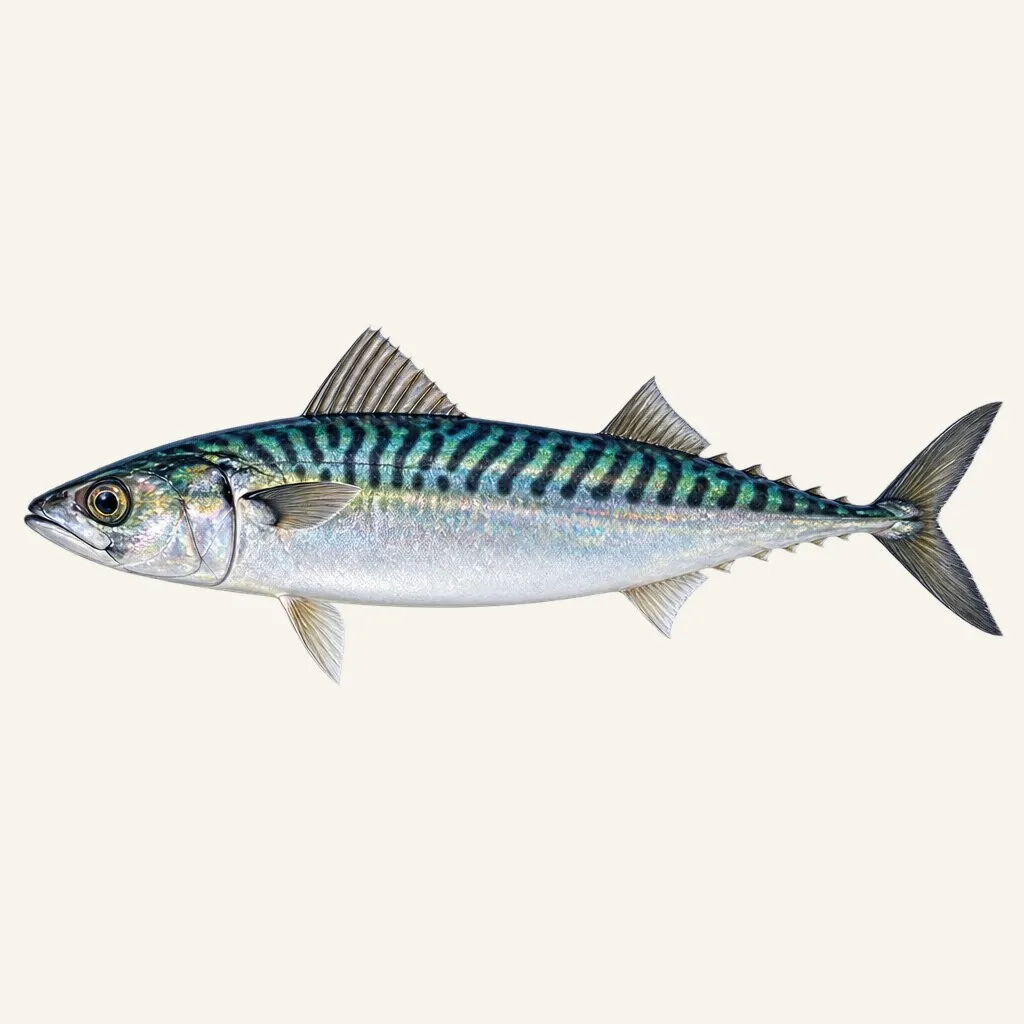
The Atlantic mackerel is a streamlined pelagic fish with metallic blue-green reflections on the back crossed by distinctive dark wavy stripes, and a silver belly. Very fast, it hunts in tight schools near the surface along European and North American coasts.
Calendar
Recorded in 23 countries
Belgium · Canada · Chile · Croatia · Denmark · Faroe Islands · France · Germany · Greece · Iceland · Ireland · Isle of Man · Italy · Lebanon · Netherlands · Norway · Portugal · Spain · Svalbard & Jan Mayen · Sweden · Türkiye · United Kingdom · United States
GBIF occurrence records — native and introduced populations combined.
Its range
The species holds the cold and temperate shelf waters of the North Atlantic, between 77°N and 30°N.
The north-east Atlantic carries two distinct stocks, the North Sea stock to the east and the western stock around the British Isles. The split is not administrative: these are populations that do not mix, and their histories differ sharply.
Identifying it
The belly of an Atlantic mackerel is unmarked. That is the quickest separation from its relatives, several of which carry spots or mottling below the lateral line.
The bars on the back run oblique to nearly vertical and undulate very little — again a comparative character, since the neighbouring species have a more sinuous pattern.
Three anatomical points finish the job. There is no well-developed corselet at the front of the body. The anal-fin spine is conspicuous, joined to the fin by a membrane but clearly independent of it. And there is no swim bladder.
That last absence is not a dissection detail. Without a bladder the fish sinks the moment it stops swimming, which forces continuous movement and explains the whole animal — the fusiform body, the smooth skin, the lunate tail.
Counts: 31 vertebrae, 8 to 14 dorsal spines, 11 to 13 soft rays, 12 to 13 anal rays.
Breeding
Mackerel are batch spawners, releasing eggs in successive lots across a season rather than all at once. Eggs and larvae are pelagic.
After spawning the adults feed hard, moving about in small shoals. That recovery phase is a complete change of behaviour — the fish shifts from a spawning concentration to mobile scattered groups.
Maturity comes at about 29 cm.
The water it needs
Mackerel form large shoals near the surface. Usual depth is 0 to 200 m, though they go to 1,000.
The annual cycle is clean and it explains the whole fishing calendar. They winter in deeper water and move inshore in spring once surface temperature reaches 11 to 14°C. That is a specific threshold, and it defines the window: not before, and not far from the coast.
They tolerate brackish water.
Areas
- Atlantic and Mediterranean coasts
- Coastal pelagic waters
- Open estuaries
- Current edges
Techniques
- Cast and retrieve with metal lure
- Light trolling
- Sea spinning
- Live bait fishing
Baits
- Light metal lures
- Coloured feathers
- Sandeels and lancefish
- Slim soft lures
What it eats
They feed on zooplankton and small fish, and are mainly diurnal — unusual among marine predators and convenient for planning a session.
The double diet explains their response to lures. A fish that both filters zooplankton and chases fry will take a string of small bright feathers as readily as a single bait.
How to catch it
Water temperature sets the season. Mackerel arrive inshore as it passes 11°C and leave as it drops back; following that threshold tells you more than a fixed calendar, and the date moves by weeks from year to year.
The shoal is the unit. A lone mackerel is an anomaly — the fish travel in large groups near the surface, and the work is intercepting the shoal rather than searching at random. Working birds and surface disturbance are the most reliable signs.
Feeding is diurnal, which is a convenience: there is no need to fish this species at night.
One consequence of the anatomy is worth knowing. With no swim bladder, a mackerel suffers none of the barotrauma that kills most fish brought up from depth, so a released fish swims off properly, which is not true of most of its neighbours on the ground.
The maximum recorded age is 17 years.
Conservation
The North Sea stock is a documented case study. It collapsed in the 1960s under direct overfishing, and recruitment there has been poor and unstable ever since. Sixty years on, recovery is not settled.
That is the useful reminder behind a species whose apparent abundance makes it look inexhaustible: a fish counted in millions of tonnes can vanish from an entire sea and fail to come back.
Mackerel are also a central prey species for a long list of marine predators, so the state of the stock is felt well beyond the fish itself.
Regulations
Check the local regulations in force (legal size limits, closed seasons, bag limits).
For guidance only. Legal sizes, quotas and open seasons vary by location and season: always check the local regulations in force before fishing.
Other names
Atlantic mackerel in English, sometimes Boston mackerel in North America. Several unrelated fish trade as mackerel — horse mackerel is a carangid, king mackerel and Spanish mackerel are Scomberomorus — so the market name says little. Maquereau in French, Makrele in German, sgombro in Italian.
Sources: fishbase.se · api.gbif.org