Dusky shark
Carcharhinus obscurus · Carcharhinidae
- Saltwater
- Sharks & rays
- Medium
- Regulated
- Dangerous
- Size
250–420 cm
- Weight
183–347 kg
- Lifespan
40 years
- Depth
0–400 m
Where to fish
- Offshore
Habitat icons: Flaticon
Dusky shark - pelagic sea fish, worldwide
Calendar
Recorded in 12 countries
Australia · Brazil · Faroe Islands · Germany · India · Indonesia · Israel · Mexico · Puerto Rico · South Africa · United Kingdom · United States
GBIF occurrence records — native and introduced populations combined.
Its range
The species is coastal and offshore but not oceanic — it does not cross the great basins. That distinction governs how its map should be read: the gaps are not gaps in observation, they are expanses of deep water it does not traverse. Its populations follow the shelves.
It is classed among the highly migratory species, and its seasonal movements have real amplitude — but they run along those same shelves, not across them.
One doubt is written into the literature itself. Certain records from the Mediterranean and Madeira may rest on Carcharhinus galapagensis, a neighbouring species of comparable appearance. The reports furthest from the main range are therefore the least secure, which is consistent with an animal that follows coastlines rather than cutting across open sea.
Identifying it
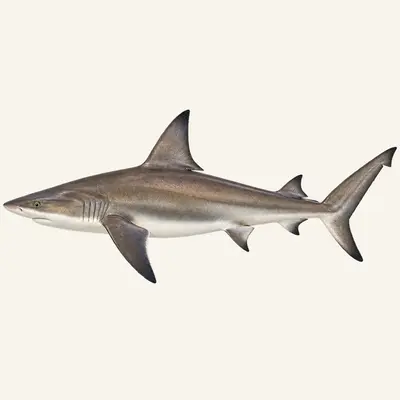
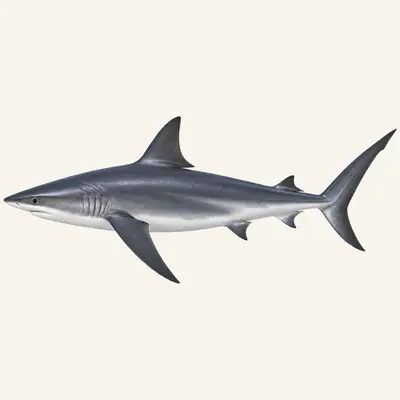
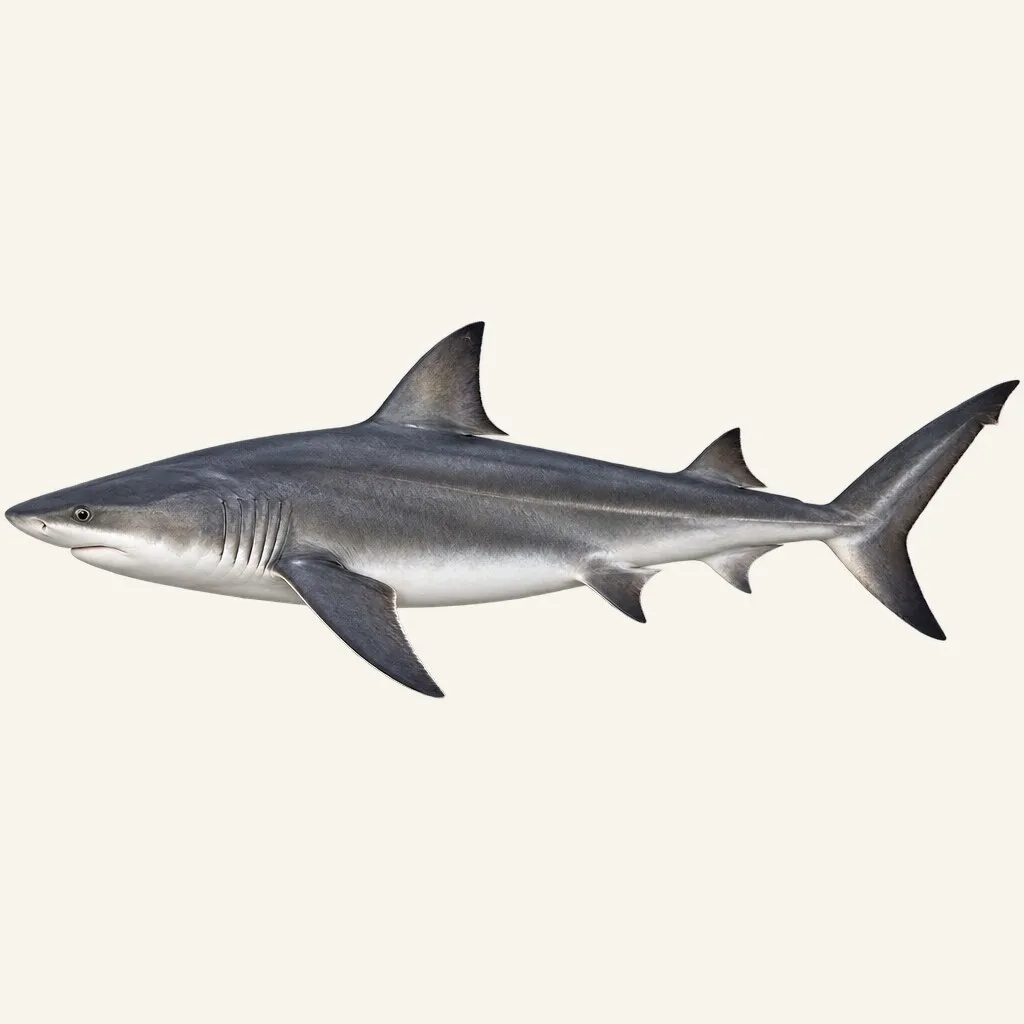
Its description contains no peculiarity, and that is what identifies it. A broadly rounded snout, triangular saw-edged upper teeth, curved pectorals of moderate size, a ridge between the dorsals: four ordinary characters and not one exception. No outsized fin, no drawn-out free tip, no displaced insertion. In the other requiem sharks identification rests on a detail that sticks out; here it proceeds by elimination.
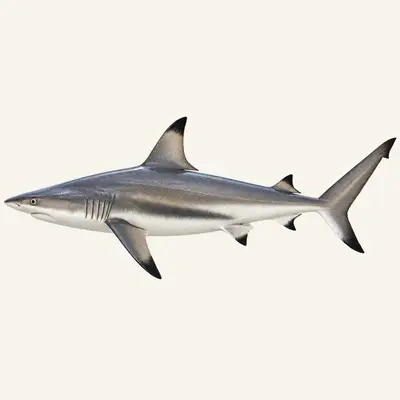
The colouring is no help either. The back is blue-grey or lead-grey, the belly white. The tips of the pectorals and pelvics, the lower caudal lobe and the dorsal fins are often dusky in young fish and plain in adults. A juvenile can therefore suggest a blacktip, but that species keeps a clean black spot on the pelvics for life, where here everything fades out.
Size then becomes the surest argument. This is the largest of these coastal sharks: 2.5 m for an ordinary individual, and a lifespan of forty years. A large, plain grey shark with a round snout and a dorsal ridge, well over three metres, has little chance of being anything else — records of the sandbar shark at that length are themselves held to be doubtful.
Breeding
Gestation lasts about sixteen months. That is more than a year and a half of carrying, where most of its relatives close their cycle inside a year, and it is enough on its own to rule out annual breeding.
The litter holds three to fourteen pups, but their size changes how that number reads: they are born between 70 cm and a metre. These are the largest newborns in the genus, and a metre-long shark escapes from its first day most of the predators that thin out the young of other species. The investment goes into the size of each pup rather than into their number.
Maturity, finally, comes extraordinarily late: between 2.2 and 3 m, averaging 2.5. A female must therefore reach nearly two thirds of her maximum length before her first birth, and then carry for sixteen months. No stage of that cycle is quick.
The water it needs
The ages do not share the same layer of water. Adults are commonly found between 200 and 400 m; the young occupy shallower water. The full range runs from the surface to 400 m, with a tolerance for brackish conditions and some use of reef margins.
That vertical separation is the practical trait of the species. It does not spread its year classes over different sectors, as the sandbar shark does, but over different depths in the same place.
Areas
- Offshore pelagic waters
- Continental shelf edges
- Convergence zones and upwellings
- Open sea far offshore
Techniques
- Offshore live bait trolling
- Drift fishing with chumming
- Dead bait mid-water
- Offshore anchored fishing
Baits
- Bonito
- Mackerel
- Squid
- Flying fish
- Sardines
What it eats
The list carries no specialisation of any kind: bottom and midwater bony fishes, sharks, skates and rays, cephalopods, gastropods, crustaceans, sometimes mammalian carrion, sometimes objects that are not food.
Two ends of that list are informative. Skates and rays call for a dentition that cuts, which the serrated triangles of the upper jaw do very well. The gastropods and the inedible objects show, conversely, an animal that does not select much before swallowing. A predator capable of both has no lean season.
How to catch it
What is met near the shore is a young fish. The adults live two to four hundred metres lower and further out, and it is longline gear that reaches them: the species is a habitual component of shark longline catches. Sport and commercial fishing therefore do not encounter the same animals, nor the same questions.
Large individuals are flagged as potentially dangerous, and a fish of three metres or more is handled accordingly, clear of the mouth and without being brought out of the water.
One detail of diet bears on presentation. This shark swallows mammalian carrion and, on the record, inorganic objects: it takes in first and sorts afterwards. A dead bait laid on the bottom fits its habits exactly, and there is no call to look for a live one.
Regulated — Often governed by quotas, size limits, seasons, or reporting rules.
Dangerous — Risky handling: gear, release, and safety practices must be adapted.
Conservation · Endangered (IUCN) — This species is threatened with extinction. Always release it (no-kill), handle it with the utmost care and check local rules — fishing for it may be prohibited.
Conservation
Renewal here is the slowest of these coastal sharks, and it is slow by accumulation rather than at any one point. A female must reach 2.2 to 3 m before her first litter; she then carries for sixteen months; she produces between three and fourteen pups; she may live forty years. Measured against the length of a fishing career, that means a stock once drawn down does not rebuild inside the time it takes to notice the decline. The fishery ends before the recovery begins.
Pressure comes almost entirely through longline gear, where the species arrives regularly without being aimed at, and nothing about the animal argues for cutting it free once it is at the boat.
What matters most in practice is what releasing one commits you to. An adult of this species may be forty years old and have produced only a handful of litters; its worth to the population has no relation whatever to its weight on the deck. A fish of that age cannot be replaced within the working life of the boat that catches it.
Regulations
Check the local regulations in force (legal size limits, closed seasons, bag limits).
For guidance only. Legal sizes, quotas and open seasons vary by location and season: always check the local regulations in force before fishing.
Other names
Dusky shark in English, and the epithet obscurus means the same thing: dark, dim. German Dunkelhai, Italian squalo scuro, French requin obscur and Brazilian Portuguese tubarão-fusco all repeat the idea of a dull shade.
Spanish is the exception with tiburón arenero, the sandy one — a line English reserves for its relative, the sandbar shark, which is a different animal. The two sharks resemble each other closely enough for their names to have crossed over from one language to the next, and that is one more reason to fall back on the scientific name when the identification counts.
Sources: fishbase.se · api.gbif.org