Silky shark
Carcharhinus falciformis · Carcharhinidae
- Saltwater
- Sharks & rays
- Medium
- Regulated
- Dangerous
- Size
250–350 cm
- Weight
115–346 kg
- Lifespan
25 years
- Depth
0–4,000 m
Where to fish
- Offshore
Habitat icons: Flaticon
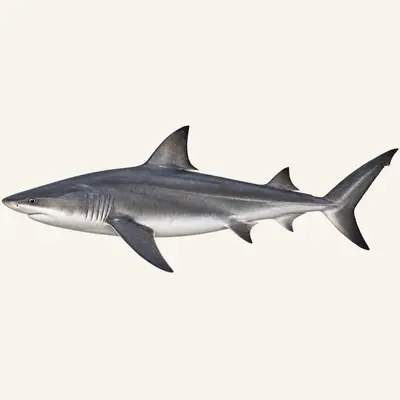
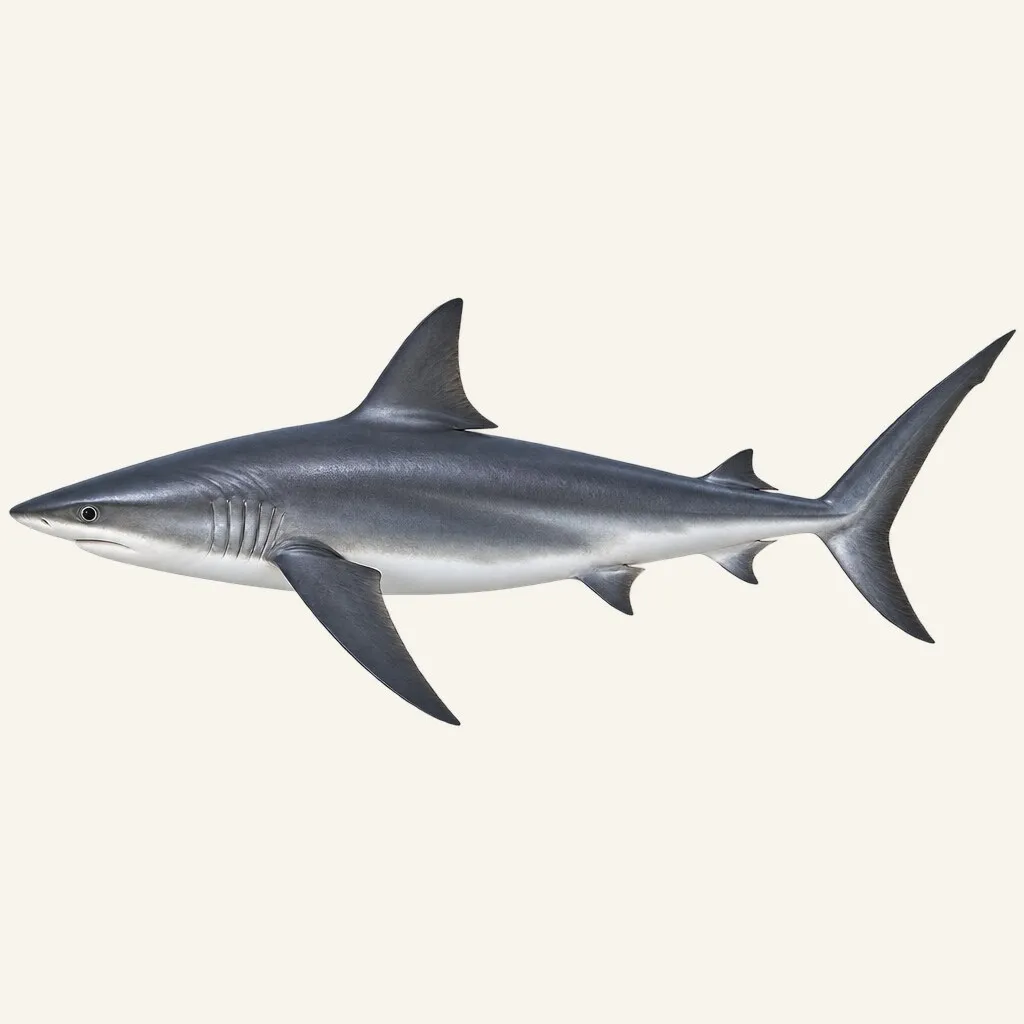
The silky shark is a pelagic species with a streamlined body and smooth-textured skin that gives it its name. Its long, pointed pectoral fins and metallic grey dorsal coloration help identify it in open ocean waters.
Calendar
Recorded in 30 countries
Angola · Australia · Brazil · British Indian Ocean Territory · Colombia · Comoros · Côte d’Ivoire · Ecuador · Egypt · Faroe Islands · Finland · France · French Polynesia · French Southern Territories · Gabon · Guinea · Kenya · Madagascar · Mauritius · Mayotte · Mexico · Mozambique · Norway · Puerto Rico · Seychelles · Somalia · Sweden · Tanzania · United Kingdom · United States
GBIF occurrence records — native and introduced populations combined.
Its range
The range is circumtropical, from 42°N to 43°S, and the species is formally recognised as highly migratory. What structures its distribution is neither the coast nor the open ocean, but the break of slope.
It is abundant along the edge of continental and insular shelves, over deepwater reefs and along island slopes. That preference for the drop-off explains the shape of its presence in the Indo-Pacific, made of scattered points rather than a continuous band: the records follow the places where the bottom falls away, and those places are themselves discontinuous. Recorded depth reaches 4,000 m, but ordinary use stays within the top 500.
Identifying it
A single character separates this shark from its whole genus, and it is a question of alignment. Here the origin of the first dorsal lies behind the free rear tip of the pectoral fin. No other Carcharhinus carrying a ridge between the dorsals is in that position: everywhere else the fin begins further forward. Comparing where the leading edge of the dorsal meets the back against the tip of the folded pectoral is enough to conclude.
The second dorsal confirms it. That fin is low, and its free rear tip draws out towards the tail into a thin filament that the profile betrays as soon as the animal is viewed from the side.
The rest composes the head of a midwater animal: a snout of moderate length, flattened and rounded at the end, large eyes, jaws small for the size of the body. The teeth carry oblique serrated cusps — leaning, where the bull shark's are frankly triangular and the blacktip's narrow and erect. The back is grey or bluish grey, with no fin markings at all.
The whole gives a long, slim shark, very different from the stocky inshore species. It reaches 3.5 m, with 2.5 m for an ordinary individual.
Breeding
Females appear to breed every year, and without a marked season: births are not concentrated in any particular period. That is a real demographic advantage in a group where breeding every other year is the rule.
Litters hold two to fifteen pups in one series of data and one to sixteen in another, and newborns measure between 55 and 87 cm.
The advantage is cancelled by the size at which it is paid for. First maturity is observed between 1.8 and 2.6 m, averaging around 2.19, in an animal whose recorded longevity tops out at 25 years. A female therefore spends the first half of her life reaching breeding size, and the width of that bracket signals that the productivity of a stock depends heavily on the region: two populations do not enter reproduction at the same age.
The water it needs
It is littoral and epipelagic, in open water or near the bottom between 18 and 500 m, sometimes closer in, more often well out. Quick-moving and aggressive in its approaches.
It is described as solitary, which does not prevent it being met in numbers: it associates with schools of tuna. Those gatherings are not social but opportunistic — the shark occupies the warm blue water where tuna concentrate, and it arrives there by the same route.
Areas
- Deep pelagic waters
- Tropical convergence zones
- Open sea beyond the shelf
- Around oceanic islands
Techniques
- Offshore live bait trolling
- Drift fishing with chumming
- Dead bait mid-water
- Offshore float fishing
Baits
- Mackerel
- Squid
- Bonito
- Small tunas
- Sardines
What it eats
It feeds mainly on fishes, with squid, paper nautiluses and pelagic crabs added. That list locates the animal as surely as a chart would: paper nautiluses and pelagic crabs exist only in open water, far from any bottom.
The jaws are small and the cusps oblique, a combination that slices prey of moderate size rather than tearing pieces from large ones. The diet confirms the dentition: nothing on that menu greatly exceeds the width of its mouth.
How to catch it
Practically nobody fishes for it, and it is nonetheless among the most heavily caught sharks on the planet. The reason lies in that tuna association: gear set on tuna schools takes it along with them, in quantity, wherever the fishery operates. This is the bycatch of the tuna fishery par excellence.
The word bycatch misleads, though. The species is classed as highly commercial, so the catch is not discarded but kept and sold. Incidental describes the intention, not what becomes of the animal.
For anyone meeting it on a line, two points count. It is quick and aggressive, and it is regarded as dangerous: its arrival on a bait in blue water is direct and fast, and its presence around a drifting boat is not quiet curiosity. It is also not necessarily at the surface — most of its activity takes place in the upper 500 m, and a fish held under the hull may have come up from a long way down.
Regulated — Often governed by quotas, size limits, seasons, or reporting rules.
Dangerous — Risky handling: gear, release, and safety practices must be adapted.
Conservation · Vulnerable (IUCN) — This species is threatened with extinction. Always release it (no-kill), handle it with the utmost care and check local rules — fishing for it may be prohibited.
Conservation
Pressure comes not from a fishery that targets it but from fisheries that target something else, and that is what makes it hard to reduce. Closing a directed fishery is a decision one authority can take; lowering this animal's mortality would mean changing the gear and the grounds of the world tuna fleet, which is a different order of problem. Nothing in the tuna catch depends on it, and nothing in the tuna catch is protected by leaving it alone.
Set against that, the demography has little slack. An average of 2.19 m before a first litter, twenty-five years of life, a dozen pups per cycle: annual breeding does not make up for a decade and a half of prior growth, and a year class removed is not replaced inside a generation.
International trade is monitored under CITES Appendix II, and the species is also listed on Appendix II of the Convention on Migratory Species. Neither instrument caps a catch. The second starts from the observation that a highly migratory stock crosses dozens of jurisdictions: it asks the states concerned to agree with one another, failing which a measure taken on one side of an ocean has no effect on the other.
Regulations
Check the local regulations in force (legal size limits, closed seasons, bag limits).
For guidance only. Legal sizes, quotas and open seasons vary by location and season: always check the local regulations in force before fishing.
Other names
Silky shark is the English name, and it comes from the skin: the dermal denticles are fine enough for the surface to feel smooth to the hand. French requin soyeux, German Seidenhai and Italian squalo seta say exactly the same thing.
The scientific name looks elsewhere. Falciformis means sickle-shaped, a reference to the curve of the fins. Brazilian Portuguese picks out something else again with tubarão-lombo-preto, the black back. Skin, fins, back: three readings of one animal, depending on what was in front of whoever named it.
Sources: fishbase.se · api.gbif.org