Atlantic bonito
Sarda sarda · Scombridae
- Saltwater
- Big pelagics
- Medium
- Size
50–91 cm
- Weight
1.3–11 kg
- Lifespan
5 years
- Water temp.
12–27 °C
- Depth
80–200 m
Where to fish
- Offshore
Habitat icons: Flaticon
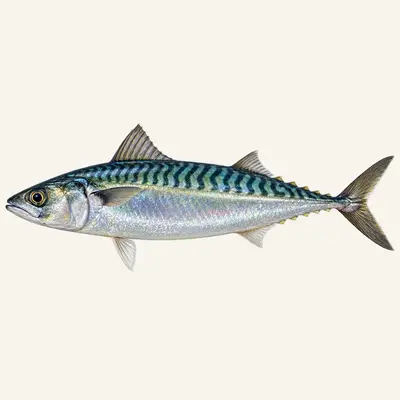
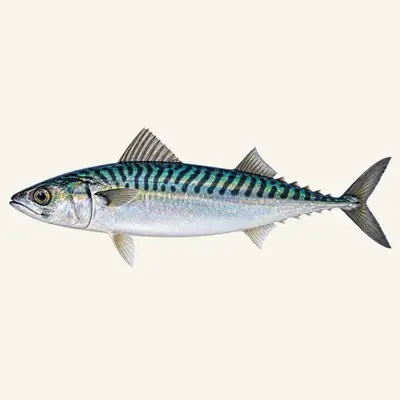
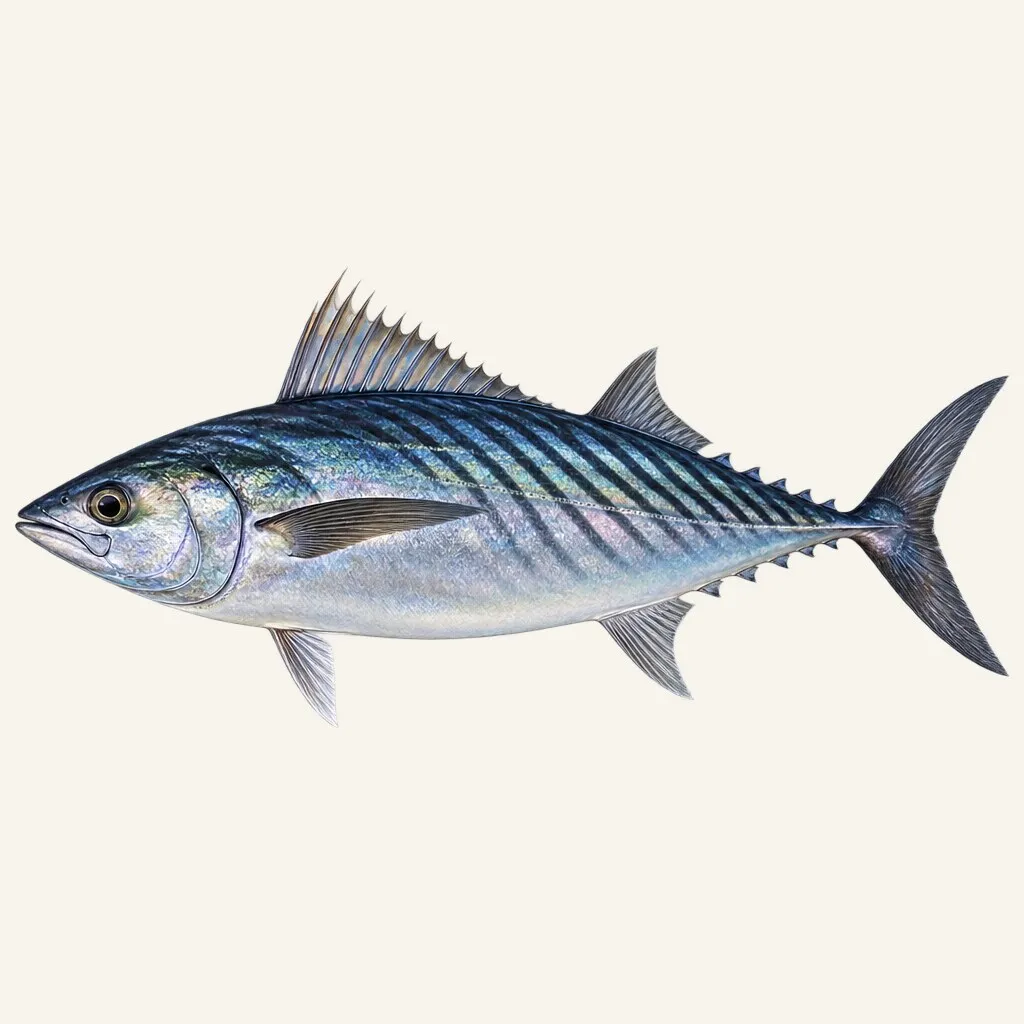
The Atlantic bonito is a streamlined pelagic scombrid recognisable by its dark oblique longitudinal stripes running across the upper third of the body. A fast migratory coastal species, it hunts near the surface in temperate and warm waters of the Atlantic, Mediterranean and adjacent seas.
Calendar
Recorded in 22 countries
Cameroon · Congo - Brazzaville · Côte d’Ivoire · Cuba · Equatorial Guinea · France · Gabon · Ghana · Guinea · Guinea-Bissau · Ireland · Liberia · Mexico · Nigeria · Norway · Portugal · Puerto Rico · Senegal · Sierra Leone · South Africa · Spain · United States
GBIF occurrence records — native and introduced populations combined.
Its range
The eastern side of the Atlantic holds one continuous range, from Oslo to Port Elizabeth, the Mediterranean and the Black Sea included. The western side is cut into three: a stretch from Nova Scotia to Florida with the northern Gulf of Mexico, a second off Colombia and Venezuela, a third from south of the Amazon to northern Argentina. Between them, most of the Caribbean Sea holds none.
That Caribbean hole is not a gap in observation. This is a shelf animal that lives in water thick with forage, and the Caribbean basin offers deep ground and clear, poor water. The bonito occupies both of its margins and avoids the middle.
The Brazilian break is stranger, because freshwater cannot explain it. The species tolerates salinities from 14 to 39 parts per thousand, which covers everything from an estuary to a hypersaline lagoon. The Amazon plume ought not to stop it, and yet the records stop there.
Identifying it
The oblique bars across the back rise at a steeper angle on this bonito than on any of its congeners. Angle is the character, not the number of lines: on the other three species the same markings lie almost flat along the body, and here they lean hard towards the nape. It reads from a metre away, on a wet fish on the deck.
The meristics then settle the matter beyond argument. This species carries 20 to 23 dorsal spines and 50 to 55 vertebrae; no other bonito exceeds 19 spines or 46 vertebrae. Nothing else in the genus is that clean, so a poorly marked fish is determined by counting rather than by looking. Behind the spines come 15 to 18 soft rays, and the anal fin has 14 to 17.
The corselet gives the animal its two-part appearance. That plate of thickened scales wraps the front of the body like a breastplate, and behind it the skin bears scales so small that it feels bare under a thumb. The change is immediate to the touch, and it confirms a scombrid rather than a jack.
Teeth are the other quick separation from a small tuna. A bonito carries a row of comparatively large conical teeth in each jaw, which is why it can take prey a tuna of the same length would leave alone. The mouth is moderately large, the interpelvic process small and forked, the swim bladder missing, and the spleen sizeable for the animal.
A common bonito measures about half the length of the largest on record.
Breeding
Maturity comes at around 38 cm, barely more than a third of the maximum length. Set against a life that does not run past five years, that earliness is structural rather than incidental: the fish has to breed early because it will not be here long.
Eggs and larvae drift in open water with no support and no guard. Nothing is deposited and nothing is watched over.
The water it needs
The breadth of tolerance defines this fish better than any single habitat. Twelve to 27 degrees, 14 to 39 parts per thousand: no other bonito spans that, and it is what allows one species to occupy both the Black Sea and the Gulf of Guinea.
It schools in the lit layer over the shelf, above coastal bottoms, and it enters estuaries. Meeting one in diluted water is therefore not an accident but a described behaviour, and it is the line between this fish and the offshore tunas, which never take the risk.
Areas
- Coastal pelagic waters
- Surface hunting areas
- Around headlands and points
- Under seabird aggregations
Techniques
- Cast-and-retrieve with metal lures
- Feather fishing
- Fast trolling
- Surface popper
Baits
- Flasher metal lures
- Coloured feathers
- Surface poppers
- Small live fish
What it eats
The menu is three items long: small schooling fishes, squid, shrimps. What surprises is the calibre. For a modest size within the family, the animal swallows relatively large prey, and the jaws allow it.
Cannibalism is established in the species. A shoal of bonito eats its own young, and that self-regulation works on the year classes before any outside predator gets to them.
How to catch it
Two facts organise the choice of lure and both push the same way. The fish takes prey that is large for it, and it eats its own kind. Going down in size is the standard error here: something built to the profile of a young bonito outfishes a small blade meant to pass for an anchovy.
Tolerance of diluted water opens a fishery the family rarely offers. River mouths, lagoon passes and the lower reaches of estuaries are legitimate ground for a fast scombrid, and turbid water is no obstacle there.
The thermometer sets the bottom of the season. Below 12 degrees the fish is not present, and that threshold is wider than most pelagics allow, which pushes the inshore window earlier in spring and later into autumn than expected.
One entry in the record sits oddly beside the rest of it: ciguatera poisoning has been reported from this fish. Ciguatoxin is built on coral ground, at the foot of a reef food chain, and this bonito is a shelf animal whose range reaches Norway — which places those reports at the warm end of a very long distribution. The consequence is geographic. A fish taken off Brittany raises no such question; the same species taken in the tropics does, and the answer is held locally rather than in any general statement about the species.
Conservation
A bonito stock never holds more than five age classes, and that is where everything turns. The old fish that serve other species as a reserve through a bad year do not exist here: a failed year class is covered by nobody, and there is no reservoir of large adults to draw the fishery through it.
The same clock runs the other way as well. A population rebuilds its numbers within a few seasons once pressure drops, which no thirty-year fish can do. The risk is therefore instability rather than disappearance, and an industrial fishery built on this animal is working a resource that swings hard from year to year without anything being lost for good.
Early maturity completes the picture in its favour. At 38 cm, a fish that has reached the common size of the catch has already spawned several times.
Regulations
Check the local regulations in force (legal size limits, closed seasons, bag limits).
For guidance only. Legal sizes, quotas and open seasons vary by location and season: always check the local regulations in force before fishing.
Other names
Atlantic bonito is the standard English name, and bonito is a market word before it is a species name. In Florida the little tunny, Euthynnus alletteratus, is habitually called bonito, so on that coast the word is as likely to mean the other fish as this one. Spanish keeps bonito del norte for the albacore, a different animal at a different price.
The genus has a long history behind it. Italian palamita and German Pelamide both come from the Greek pelamys, which in antiquity meant a young tuna, and this fish carried the genus name Pelamys for a long time before it settled where it now sits.
Sources: fishbase.se · api.gbif.org