Atlantic pomfret
Brama brama · Bramidae
- Saltwater
- Big pelagics
- Medium
- Size
40–100 cm
- Weight
0.8–6.0 kg
- Lifespan
9 years
- Water temp.
12–24 °C
- Depth
0–1,000 m
Where to fish
- Offshore
Habitat icons: Flaticon
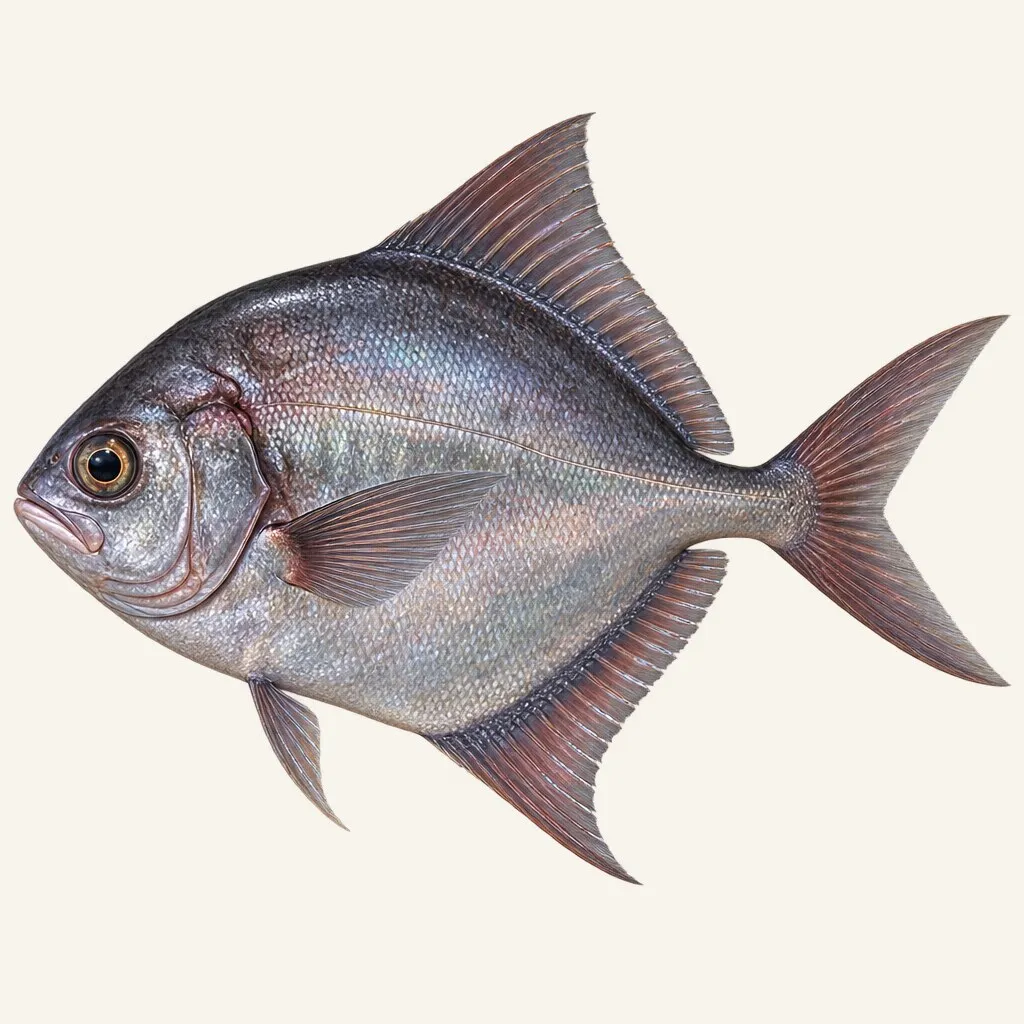
The Atlantic pomfret is a deep-bodied, laterally compressed pelagic fish with a rounded profile, prominent keeled scales, and a large sickle-shaped caudal fin. Its uniform silver-grey metallic coloration is distinctive. It inhabits temperate and subtropical waters of the Atlantic and other oceans at mid-depths.
Calendar
Recorded in 9 countries
Argentina · Australia · Belgium · Ireland · Netherlands · New Zealand · Norway · Spain · United Kingdom
GBIF occurrence records — native and introduced populations combined.
Its range
Three oceans, and the shape of the occupation is worth setting out. In the eastern Atlantic the range runs from central Norway south to Algoa Bay in South Africa — the whole European and African seaboard in one continuous stretch. In the western Atlantic it goes from Nova Scotia and Bermuda down to Belize and the Antilles, with separate records from Brazil and from Argentina. Beyond the Atlantic the species is recorded in the Indian Ocean and in the South Pacific. The extremes given are 65 degrees north and 70 degrees south.
Two figures explain more of that than the list does. The species is recorded between 12 and 24 degrees of water temperature, and its depth range reaches 1,000 m against a usual band of 0 to 200. A fish with a kilometre of water beneath it can find 12-to-24-degree water below a surface that is far warmer, and that is one way of reading a range which contains both Norway and Belize: the thermal envelope is constant, and it is the depth at which the envelope sits that moves.
Identifying it
The fins are scaled. Both the dorsal and the anal carry scales over them and rigid rays inside them, so they read as extensions of the body rather than as membranes stretched on a frame. Run a finger along the base of either one and it does not fold the way a fin is expected to.
The body behind them is deep and strongly compressed, with a head profile that curves steeply from the snout to the nape — a tall, flat, blunt-fronted fish. Neither the dorsal nor the anal holds a spine anywhere along its length: 35 to 38 soft rays in the first, 29 to 32 in the second, over 41 to 45 vertebrae.
A common fish measures 40 cm to the base of the tail, and nine years is the greatest age on record. No length at first maturity has been published, so a measurement says nothing about whether an individual has spawned.
The water it needs
An oceanic and epipelagic animal, holding the top 200 m as a rule and recorded down to 1,000. It comes close to shore only occasionally.
It travels in small schools and it is a seasonal migrant, and the record attaches those movements to temperature rather than to a date. That is the practical form of the fact: the arrival of this fish in a given sector is a thermal event. It happens when the water reaches a condition, which is not the same week every year and can be several weeks out either way.
Areas
- Offshore open sea
- Continental slope
- Oceanic trenches
- Deep pelagic waters
Techniques
- Deep drift fishing
- Pelagic longline
- Night live bait fishing
- Deep trolling
Baits
- Squid
- Small whole fish
- Shrimp
- Mackerel
What it eats
An opportunist, and the published list shows what the word buys: small fishes, cephalopods, amphipods and euphausiids.
The span across that list is the interesting part. Amphipods and euphausiids are animals of a centimetre or two, taken in numbers; squid and small fishes are single prey items several times the size. One animal working both ends of that range is not matched to a particular prey, which is what allows a seasonal migrant to feed in water it has just arrived in.
How to catch it
The species supports a commercial fishery and is sold fresh and frozen.
For anyone fishing it, the temperature link is the whole of the planning. A seasonal visitor whose movements follow the water and not the calendar has to be intercepted on the strength of a thermometer, and the same fortnight in two successive years can be early once and late the next.
Depth then decides the presentation. The usual band is the upper 200 m, so a bait working the top of the water column is in the right place most of the time — but the recorded range goes to 1,000, and a fish that is not showing near the surface has a great deal of water underneath it to be in.
Small schools are the unit. This is not an animal that arrives in tonnages, and a capture is worth working out from rather than treating as an isolated event.
Conservation
There is a gap in the record that matters more than any figure in it. Nothing has been published on the reproduction of this species — no spawning season, no fecundity, no length at first maturity, no site. It is fished commercially across three oceans, and the part of its biology that would say what the fishery can take has never been measured.
That is not an argument for alarm; it is an argument about what can be known. Without a maturity length, the size composition of a catch cannot be read as a signal, and a fishery on a nine-year fish is operating without the one number that would tell it whether the animals in the net had bred.
Regulations
Check the local regulations in force (legal size limits, closed seasons, bag limits).
For guidance only. Legal sizes, quotas and open seasons vary by location and season: always check the local regulations in force before fishing.
Other names
Atlantic pomfret in English, and Ray's bream in British usage, which is the name most likely to appear in an older account from the north-east Atlantic.
Neither name places the fish correctly. It belongs to the Bramidae, and it is neither a bream nor a jack, whatever the deep compressed outline suggests — the resemblance is a matter of body plan, a shape that open-water fishes have arrived at repeatedly from unrelated starting points. Pomfret is likewise a market word attached to several deep-bodied fishes of different families.
The scientific name is a tautonym, genus and species the same word, which happens when a species is the one the genus was erected around.
Sources: fishbase.se · api.gbif.org