Wreckfish
Polyprion americanus · Polyprionidae
- Saltwater
- Coastal
- Medium
- Size
80–210 cm
- Weight
6.7–100 kg
- Lifespan
80 years
- Depth
40–600 m
Where to fish
- Rocky shore
Habitat icons: Flaticon
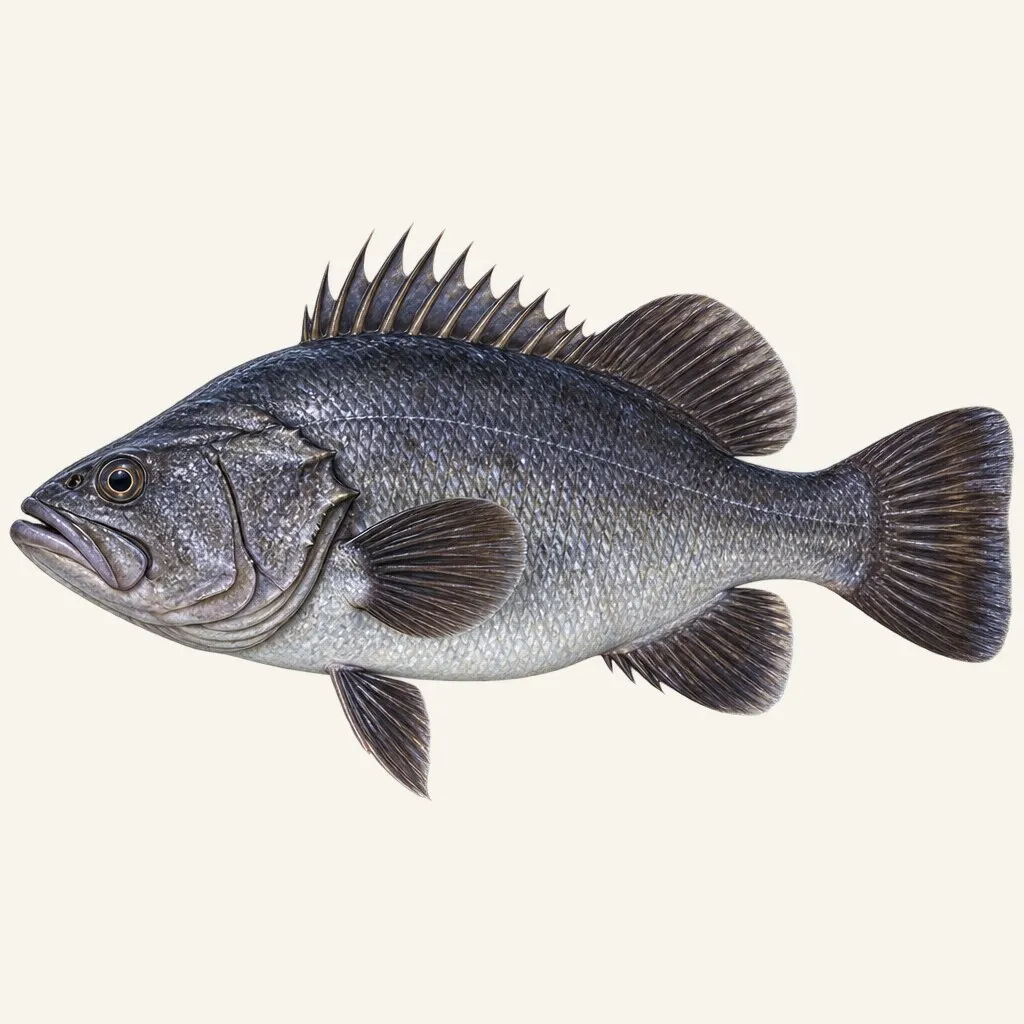
A large, robust fish with a massive oval body and a prominent bony ridge on the opercle; dark grey-brown coloration with a paler belly.
Calendar
Recorded in 12 countries
Argentina · Australia · France · Ireland · Italy · New Zealand · Norway · Portugal · South Africa · Spain · United Kingdom · United States
GBIF occurrence records — native and introduced populations combined.
Its range
Read the list before drawing any conclusion from it. Eastern Atlantic: Norway to South Africa, taking in the Mediterranean, the Canaries, Madeira, Cape Verde and Tristan da Cunha. Western Atlantic: Newfoundland and the Gulf of Maine to North Carolina, with records from Uruguay to Argentina. Western Indian Ocean: St Paul and Amsterdam islands. South-west Pacific: New Zealand.
No solitary adult tied to a cave at 150 m assembled that. Sedentary fish do not colonise both margins of an ocean, let alone three oceans and a set of islands in the middle of nowhere.
The drifting phase is what makes it possible. A juvenile that lives under floating objects in the open sea goes wherever the object goes, and what drifts crosses an ocean. Tristan da Cunha, St Paul and Amsterdam are exactly the sort of landfall that produces: mid-ocean rock, unreachable along a coastline, ordinary for something arriving on the surface. The two facts sit in the same document, and the second is the mechanism behind the first. The surface phase is not a curiosity of youth, it is the species' means of transport.
Identifying it
A rough bony ridge runs across the upper part of the gill cover. It is felt before it is seen, and on a fish coming over the gunwale that is the character to reach for first.
Around it, a heavy outline: body tall and compressed, head large, mouth large. Bluish grey above, paler below with a silvery sheen, the fins blackish brown. Ten to 12 dorsal spines with 11 to 13 soft rays behind them, three anal spines and eight to 10 rays.
A juvenile does not look like that. It carries black blotches on the head and body, and loses them. One species, two liveries — and the reason is that it is also one species with two habitats, which the rest of this page is largely about.
Breeding
The sexes are separate from the outset. The source uses a precise term for it — primary gonochorism — and it is worth registering, because it rules out the whole line of reasoning that applies to the sex-changing groupers this fish is sold beside. The length of a wreckfish says nothing about its sex, and a large one does not belong to a sex the smaller ones lack.
Spawning takes place in summer. Length at first maturity is reported around 77.9 cm, with the range extending to 90.
The water it needs
Adults prefer caves and shipwrecks, usually alone. Recorded depth runs from 40 to 600 m, and the band that actually holds them tightens to 100 to 200.
Juveniles live at the other extreme of the same ocean. They congregate below floating objects, at the surface, out of sight of any bottom at all. No cave, no relief, no structure — a shadow that drifts.
Moving from one to the other is a descent, and it is probably the single largest event in this animal's life. Light, pressure, scale and company all change in one step, and nothing about the fish at the top of it predicts the fish at the bottom.
Areas
- Deep wrecks
- Rocky drop-offs
- Deep Atlantic bottoms
- Underwater canyons
Techniques
- Deep jigging
- Heavy bottom rig fishing
- Deep trolling
- Deep live bait fishing
Baits
- Whole squid
- Large whole fish
- Octopus
- Heavy jigs
What it eats
Large crustaceans, cephalopods and bottom-living fishes.
Not one of those three is small, and the head is built accordingly. An animal living alone at 150 m, in a place where encounters are infrequent, has no incentive to be selective: what it needs is the ability to swallow whatever passes, at whatever size it happens to arrive.
How to catch it
Solitary is the word that organises the fishing. A wreck holds a fish, sometimes two — not a shoal. The resource is a collection of points, each with an occupant, and it is worked as a list of marks rather than as a population to be searched for.
The useful band closes around 100 to 200 m and it has to be real structure: caves, sharp drop-offs, wrecks, canyon walls. Away from relief there is nothing to look for, and ground that merely happens to be the right depth produces nothing.
Prey size sets presentation size. Whole squid, whole large fish, octopus, heavy jigs. A fish whose diet is built from large cephalopods and large crustaceans will not turn for a modest offering, and an under-scaled rig is working against itself before it reaches the bottom.
Conservation
Eighty years is the maximum reported age. A wreckfish can be older than the boat that brings it up, and that single figure ought to change how a capture is regarded.
Two more numbers put it sharply. First maturity is reported from about 78 cm and may not arrive until 90; the common length is 80. The ordinary fish, in other words, has either just started breeding or has not started.
Position adds its own exposure. A solitary animal faithful to one cave or one wreck is an animal at a known address, and once the mark is recorded it does not move away from the pressure. Effort concentrates where the fish cannot relocate, which is the opposite of how a mobile stock absorbs fishing.
The state of knowledge may be the most uncomfortable item on the list. The reference global assessment was made in April 2003 and has not been taken up since. For a fish present in the Atlantic, the southern Indian Ocean and the south-west Pacific, taken commercially, and long-lived enough that the effects of removals need decades to become legible, more than twenty years without a fresh look is a blind spot rather than a reassurance.
Regulations
Check the local regulations in force (legal size limits, closed seasons, bag limits).
For guidance only. Legal sizes, quotas and open seasons vary by location and season: always check the local regulations in force before fishing.
Other names
English names this fish after its address, and German does the same: wreckfish, Wrackbarsch, the wreck perch. Italian prefers the depth, cernia di fondale. Spanish and Portuguese keep cherna and cherne, French cernier.
The genus name is built from the Greek polys, many, and prion, a saw, which the rough ridge across the gill cover earns easily enough.
The epithet is the misleading part. Americanus suggests an American fish, when the species occupies both sides of the Atlantic, the southern Indian Ocean and the south-west Pacific. America is one section of that range, and not the largest.
Sources: fishbase.se · api.gbif.org